Early Enabling Works (EEW)
Schiphol has connected the Netherlands with the rest of the world for more than 100 years. During that time, much has changed in terms of quality, safety and sustainability. To keep meeting these requirements in the future, we are continuing to invest in our airport. As part of the Southern Development (Zuidelijke Ontwikkeling) project, we are doing this by building a new baggage basement and investigating whether we can build a new terminal on top of it. This is necessary to create extra space that we can use to replace older parts of the baggage system and renovate existing terminals and piers. Before we can start, we need to carry out various preparatory works.
EEW is the preliminary work for the Southern Development
EEW stands for Early Enabling Works, and this sub-project will ensure that the Southern Development area is cleared of functions. This means that we are removing all existing buildings at the site where the new baggage basement will be built. These include restaurants, shops and service points.
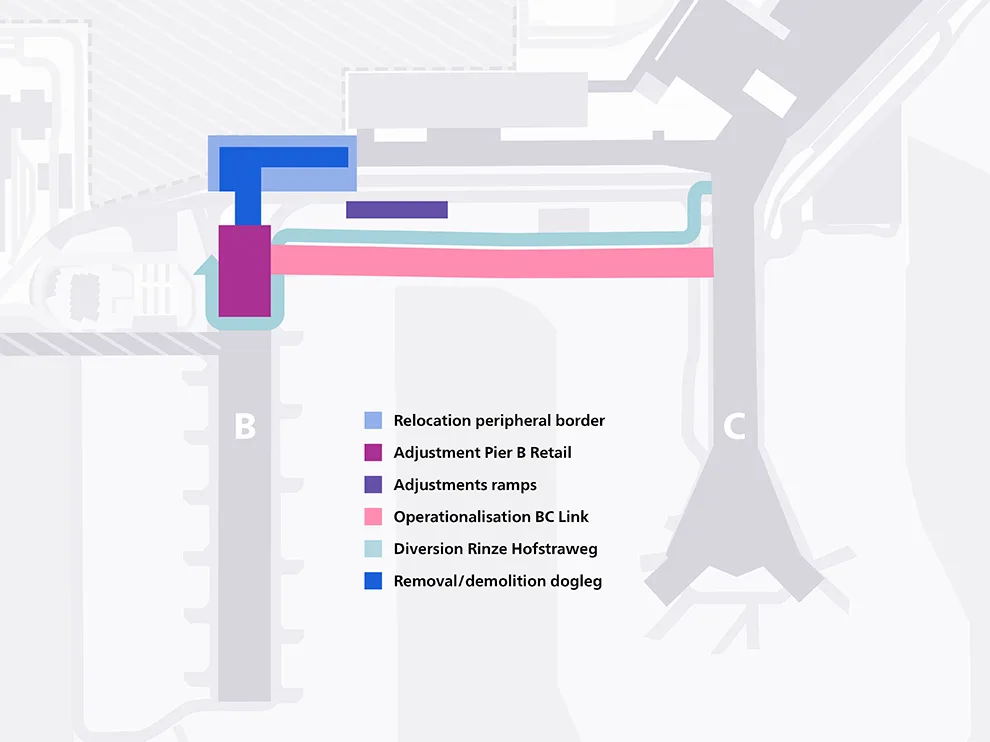
The passenger connection we call the dogleg will also be removed. Travellers will not notice this, because we are designing the area in such a way that they can continue to easily reach their flights. When we close the dogleg and reroute Rinze Hofstraweg, we will immediately open a new passenger connection: the BC Link.
Overview of the locations
Clearing the area of functions in 6 steps
1. Removing shops and catering outlets at Pier B
The dogleg section of the BC Link currently houses several shops and catering outlets. These will be removed and rebuilt further along Pier B. This way, we can ensure the environment remains pleasant and comfortable for travellers.
2. Constructing a new passenger link
Travellers should not experience any inconvenience because of these construction works. That’s why we’re finishing the BC Link, that was built in 2019, so that travellers can make use of it. Six moving walkways (three in each direction) will be installed to speed up the walking route and shorten travel time.
3. Rerouting Rinze Hofstraweg
Rinze Hofstraweg is currently located exactly where the new baggage basement will be constructed. We are therefore rerouting the road underneath the new BC Link so that this important ring road remains accessible for traffic. Once the entire Southern Development project has been completed, the road will be moved back to its original location.
4. Making the construction site landside
We are designating the work area as ‘landside’ instead of ‘airside’. As a result, fewer passes and checkpoints are required for vehicles delivering or picking up materials. This also improves traffic flow in other areas, such as Rinze Hofstraweg.
5. Adjusting the entrance to baggage basement South
One of the entrances to baggage basement South is along the Rinze Hofstraweg. Rerouting that road means we also need to change the entrance. We’re doing that by turning the ramp slightly and making it steeper. Baggage trolleys will still be able to make the turn this way. Where possible, we will reuse existing structures.
6. Dismantling the dogleg
Lastly, we’ll be clearing the dogleg of functions. This involves removing cables and installations that are no longer necessary, and rerouting pipelines. We’ll try to reuse these materials as much as possible. For example, we are currently investigating how we can reuse part of the passenger bridge in another project at Schiphol. When the dogleg is cleared of functions, the various bridge parts and the corner core can be removed. After that, we’ll remove the surfacing and reroute cables and pipes.