Our vision to orchestrate (autonomous) airside traffic Orchestrating Traffic Information System (OTIS)
OTIS stands for Orchestrating Traffic Information System – our vision for a solution that will enable efficient (autonomous) traffic flows on Schiphol airside. By having a holistic view on traffic OTIS will be able to optimize traffic by performing intersection management, prioritization and optimizing routes.
The challenge ahead
Royal Schiphol Group aims to operate the most sustainable and high-quality airports in the world by 2050. Building a more sustainable and zero emission ground operation contributes to this. We envision that by 2050, all vehicles will have been replaced by an interconnected fleet of autonomous, emission-free vehicles and all associated processes will be automated.
This journey will not be easy, especially given the limited space at Schiphol’s airside. We have to find smart ways to optimize the large amount of traffic that comes with operating a large international hub airport. Autonomous vehicles will bring lots of benefits, but will also bring challenges, and that is why we believe an traffic orchestration system can not only provide value, but might prove to be essential for our future operations.
What is OTIS, and how does it fit in the bigger ecosystem?
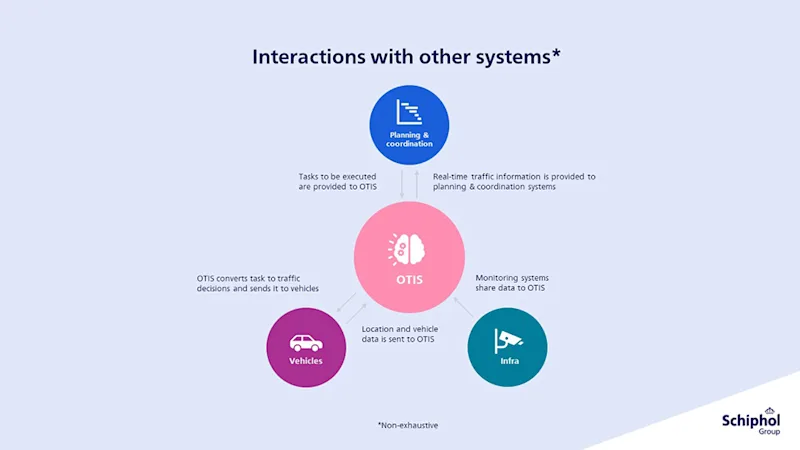
OTIS is the “brain” that orchestrates airside traffic and is an enabler of autonomous vehicles on airside. OTIS takes tasks and information from other systems as input and translates these into traffic decisions. By means of intersection management, prioritization and route optimization it will enable an efficient flow of traffic.
It interacts with the following (type of) systems:
- Planning and/or coordination systems: planning/coordination systems determine the tasks to be executed (e.g. baggage needs to be picked up from aircraft), OTIS then translates these task into traffic decisions. OTIS also communicates back actual traffic data that can be used to optimize planning and coordination.
- (Autonomous) vehicles: This is where the imposed traffic decisions given by OTIS are executed. Low-level decisions (such as collision avoidance) will be performed on a vehicle level. Vehicles will also send location data and vehicle information data – such as battery level, milage, etc. – back to OTIS.
- Monitoring systems: Other information that can impact airside traffic is shared with OTIS. This can include scheduled maintenance that blocks (parts) of the roads but could also include temporary blockages caused by vehicles or items.
Working towards our vision
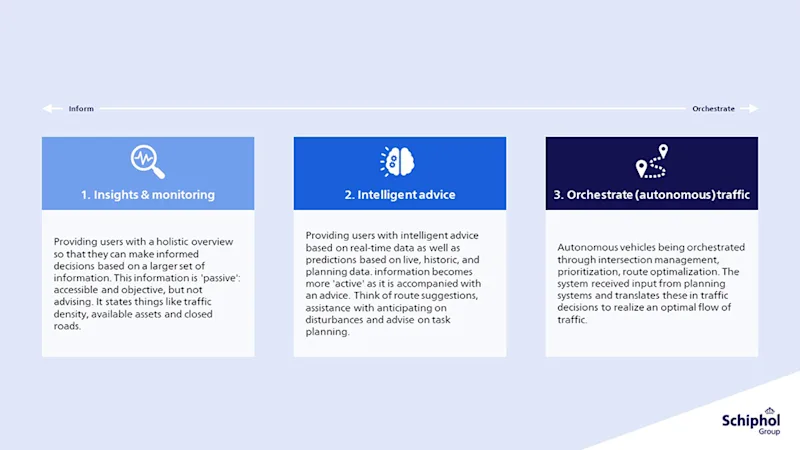
Orchestrating (autonomous) traffic won’t happen overnight, but we don’t want to sit quiet and wait. We have broken down our vision in three separate blocks and want to start building on what is possible on the short term; getting insights into the current situation and creating an holistic overview for all airside users.
To do so we are evaluating different solutions to map traffic flows and collect other traffic information in other to share this with stakeholders to validate the value of having a holistic overview.