Blog · 27 August Towards autonomous transport at Schiphol
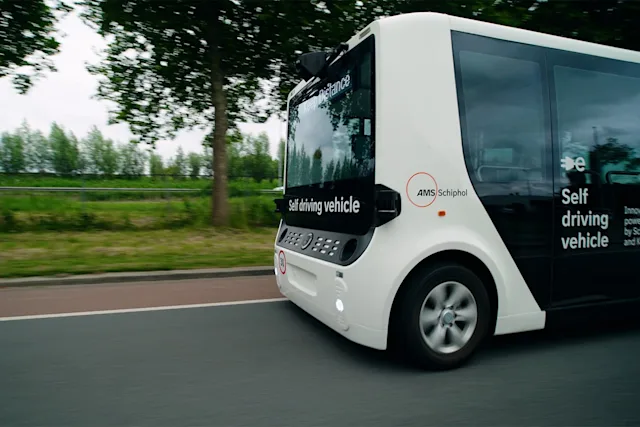
Every day, many passengers and employees travel from one place to another at Schiphol. Making this happen safely and smoothly requires a lot of organization. That's why Schiphol is researching how transport across the airport can become faster, more efficient, and more sustainable in the future. This includes looking at vehicles without a driver.
To discover how this works in practice, Schiphol tested a self-driving bus at Schiphol-Oost together with KLM. This pilot was a follow-up to an earlier study carried out in 2024 at Schiphol-Centrum.
Staff shortages and the demand for efficiency
Transporting staff and passengers across an airport site is essential for smooth operations and has traditionally been done by drivers. Unfortunately, there aren't always enough drivers available. At the same time, there is a growing desire to deploy faster, cleaner vehicles at the airport.
Schiphol saw an opportunity here: if ground transport can be operated autonomously, it creates room to deploy staff more efficiently, while at the same time moving the airport a step closer to a cleaner, more robust future.
Pilot with self-driving bus at Schiphol Oost
From January through the end of July 2026, Schiphol and KLM tested a self-driving bus at Schiphol-Oost. The pilot expanded upon earlier tests, which provided initial experience with autonomous vehicles at the airport.
This time the bar was set higher: the goal was to achieve level 4 autonomous driving. At this level, a bus drives independently, without a safety operator on board. Instead, a safety operator monitors the bus remotely via screens and can intervene if necessary.
To reach this level, it was important to gather valuable data and gain insight into how the bus responded to the dynamic environment of Schiphol-Oost. The bus drove a predetermined route while a safety operator was still on board to monitor the system. Testing then continued with passengers on board, consisting of Schiphol and KLM employees. Their feedback provided valuable insights to improve the travel experience step by step.
The key milestone of the pilot was moving the safety operator from the bus to a control room at the airport. From that point on, the bus was monitored entirely remotely. The operator maintained continuous watch via screens and could intervene when needed, for example, when the bus encountered an obstacle it could not navigate on its own. This brought the pilot a step closer to fully autonomous transport at Schiphol.
This pilot was a first step towards a future in which multiple self-driving vehicles operate at the airport and can be monitored by a single safety operator from a control room. The project's goal extended beyond simply testing the technology. During the pilot, valuable knowledge was also gained about the interaction between the vehicle, passengers, the airport environment, and other road users. In addition, the pilot provided insights into how people experience autonomous transport. Particularly in a tight labor market, this development can be highly significant. In the longer term, autonomous transport offers opportunities to transport passengers and staff efficiently and can help address future capacity and staffing challenges at the airport.
Next steps
With the knowledge gained from the first testing phases, we will continue working on the deployment of autonomous vehicles at the airport in the coming period. Step by step, Schiphol is working towards an airport where we integrate autonomous vehicles into daily airport traffic.