Since the end of 2025 TTOP1 is no longer in use as a storage site for PFAS‑contaminated soil. It is now fully designated as the ‘circular hub’ for the recycling of construction materials. For this reason, a final investigation has been carried out at TTOP1. This is standard procedure when the storage of contaminated soil comes to an end.
The conclusion of the soil investigation is that the soil quality has not been negatively affected by the storage activities. The values of the PFOA and PFOS measurements in the groundwater fluctuate within the margins commonly observed in soil investigations. Such fluctuations are the result of external factors, such as weather conditions or disturbances to the soil balance caused by activities at the location.
At the storage locations, we use three-layer co-extrusion foil. This is resistant to frost, sun and chemicals, among other things. It is often used in construction and to cover contaminated soil. At the storage locations we use the 0.20mm variant.
After a lot of research, we decided on the soil remediation process by DEME. The soil treatment facility works using a cleaning process especially for soil containing PFAS. The good solubility of PFAS is made use of in this process. The most important parts in this process are the separation of the fine fraction (sludge) and the coarse fraction (sand) in combination with the cleaning of the soil.
This soil cleaning technique is already being used at several DEME soil recycling centres, under the supervision of the appropriate authorities. After cleaning the Schiphol soil, 80% reusable sand is left. The rest (20%) is contaminated sludge. That residual sludge still contains some PFAS, but a large part of the PFAS ends up in the water used to clean it.
After cleaning the soil, there is PFAS in the water. The cleaning water is not a waste fraction and is not discharged. It is always reused in a closed system and purified in the process itself.
The water passes through activated carbon filters to remove the PFAS.
The activated carbon filters are cleaned by way of a heating process. DEME does this through a partner who has the relevant expertise.
To make sure that the cleaning process works for our own soil, we have done extensive testing under the supervision of independent experts. The soil at Schiphol that needs to be cleaned contains an average of 20% clay and loam (fraction <63 μm, also known as 'sludge' or 'lutum'). The proportion of sludge is important for soil remediation. The treatment facility can even work with soils of up to 40% sludge. Laboratory tests were carried out that mimic the cleaning process. The results were positive. After that, a full-scale test cleaning was carried out with soil that we brought to Belgium by ship. This test cleaning also gave good results. At DEME's soil remediation plant in Kallo (Port of Antwerp), 1013 tonnes of our Schiphol soil was cleaned. The cleaning efficiency of PFOS was over 99%.
The first storage locations (TTOPs) for PFAS-containing soil were commissioned in 2017. We have assessed the quality of the soil in the adjacent ditches a number of times since then. These measurements usually took place before work was done, such as dredging or shoring.
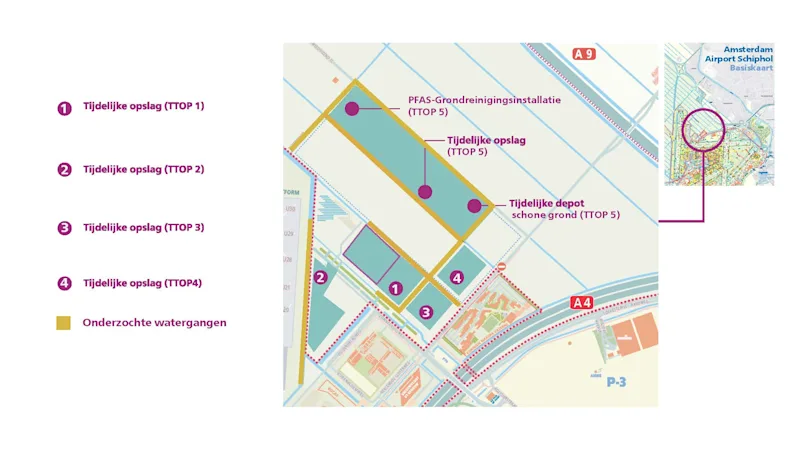
The image below shows the water ditches we have data from in dark yellow. Measurements were taken of the consolidated soil at the bottom of the water ditches and of the unconsolidated sediments.
The table below shows the results of the measurements based on reports by Terrascan and checked against current regulation limits.
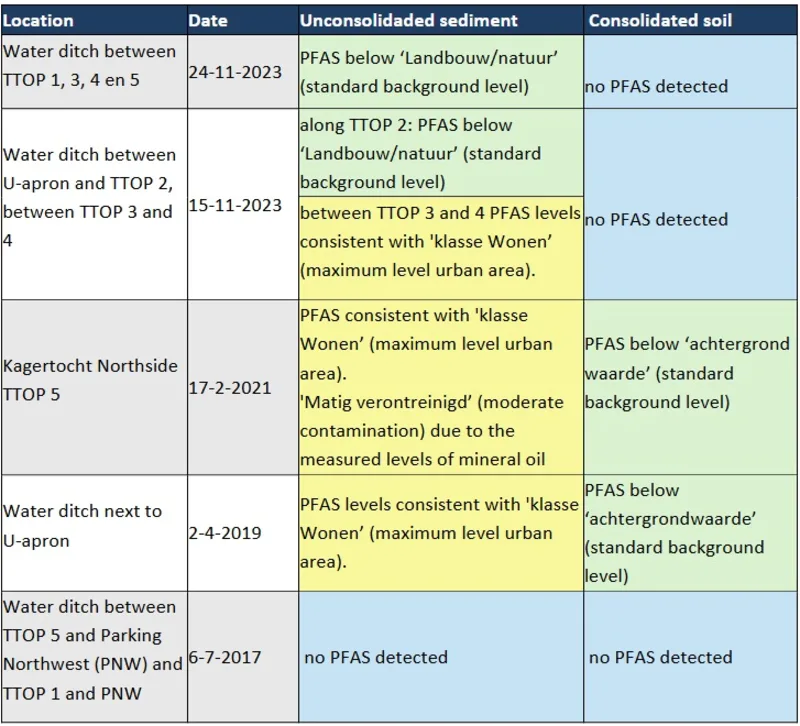
A ‘Landbouw/natuur’ (background level) classification indicates how much PFAS is commonly found in soil in places where there is no source of contamination (relatively unaffected locations). If the PFAS concentration is equal to or lower than the background level, it may be reused anywhere. The nationally established background level for PFAS is 1,4 µg/kgds and 1,9 µg/kgds for PFOA. More information on this can be found on the government website (in Dutch).
If the PFAS concentration complies with 'klasse Wonen’, this means that the soil is reusable at sites with urban or industrial use provided the site where it is used has a comparable (or worse) quality (The nationally established limit value for 'klasse Wonen’ for PFAS is 3,0 µg/kgds and 7,0 µg/kgds for PFOA.).