News · 14 October 2025 Put to the test: how pile test contributes to smarter foundations
At Schiphol, a significant step is being taken toward the construction of the new baggage hall. A foundation that is both literally and figuratively firmly planted in the ground is crucial. But how can you be sure that your foundation piles are not only strong enough, but also efficient, sustainable, and feasible within the specified requirements? To find out, we conducted a pile test – a technical yet exceptionally valuable study that provides significant insight.
Wat is een paalproef?
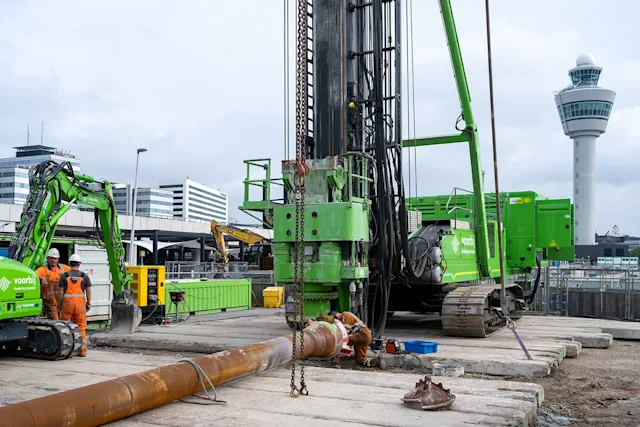
A pile test is a test in which foundation piles are manufactured and then subjected to extreme loads to analyse their behaviour in the ground. In this case, seven VSP combination piles were manufactured by Voorbij Funderingstechniek, right next to the future location of the baggage handling hall.
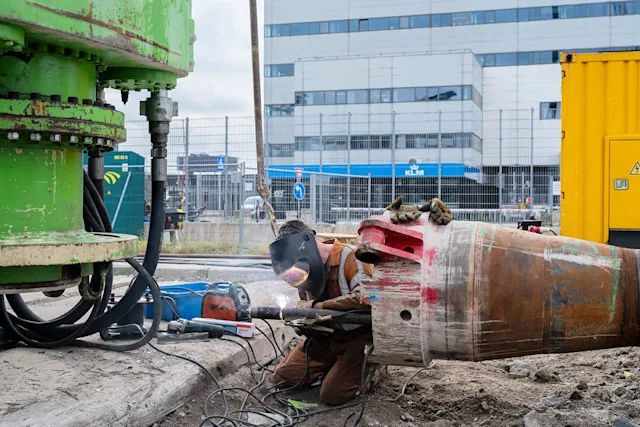
These so-called VSP combi piles are vibration-free and are electrically screwed into the ground using a steel tube. A precast concrete core with reinforcement is placed inside the tube at the desired depth, after which the tube is removed. What remains is a round concrete pile.
Of the seven piles, three ‘dummy piles’ have been installed to a greater depth to test the technical feasibility of the intended pile tip level. These piles also provide valuable data on the energy and time required for production. The remaining four piles are ‘test piles’, specifically shortened to allow for controlled failure under load. This provides insight into the piles' load-bearing capacity within the local soil.
Why is this test so important?
The results of the pile test are essential for the design of the baggage hall’s foundation. A total of approximately 3,000 piles are required for the project. The way these piles are manufactured directly affects their load-bearing capacity. Standard calculations assume conservative pile class factors, but a comprehensive pile test allows for the identification of site-specific factors, which can lead to shorter or fewer piles, resulting in a more favourable construction time and lower costs.
In addition, the entire construction process must be emission-free. This means that pile production must also be fully electric. The test provides important information about energy consumption, the required production time, and potential risks associated with electrifying the foundation process.
The pile test in practice
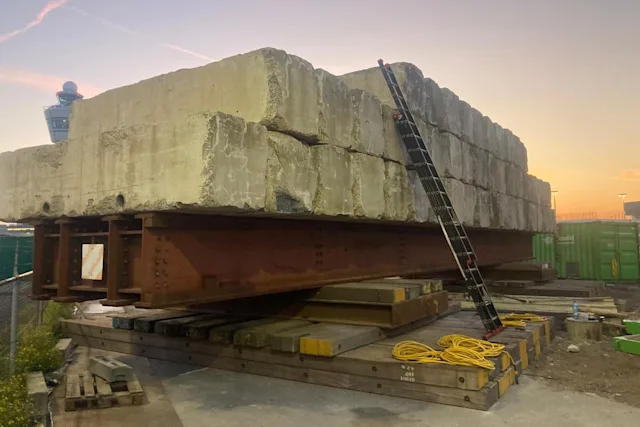
The test is being conducted carefully and in accordance with established protocols. First, soundings are performed to analyse the soil conditions. Then the piles are produced, and while the concrete is curing, a heavy-duty test setup (a large steel structure on which concrete blocks are stacked) is built.
Each test pile is then individually loaded using jacks. Over the course of a workday, the load is gradually increased until the pile fails. During this process, sensors accurately measure the deformation, strain, and compression within the pile. Afterward, the pile is also pulled from the ground to investigate how the concrete has formed around the precast core.
Safety and precision are key
Safety is a key pillar within the Fundament consortium (Dura Vermeer and Mobilis). Together with Schiphol and other involved parties, all risks were identified and managed in advance. The rig itself was also robustly constructed, using high-strength concrete and extra-rough precast cores to ensure maximum force transfer. A complex operational environment like Schiphol naturally requires close coordination with the surrounding area. Risks and disruption to the surrounding area are minimised. The pile test also serves as a valuable test for construction logistics and safety on and around the construction site.
Another challenge lies in precisely inducing pile failure without premature failure of the test rig or equipment. This requires a careful balance between theory, engineering, and execution.
What are the outcomes?
The measurements will soon yield a wealth of valuable information that can significantly improve the further design and implementation process. This includes:
- Pile behaviour: Insight into stiffness, deformation, and load-bearing capacity. These insights are incorporated into a so-called Self-Declaration; a document that establishes the pile class factors for this pile type for Schiphol's foundation. This Self-Declaration is reviewed and published by the standards committee. It forms the basis for the final foundation design of the baggage handling hall.
- Feasibility: The test demonstrates the maximum achievable pile length.
- Energy consumption and electrification: During the pile test, NRG Group accurately measures the actual power consumption of the foundation rig and supporting equipment. Given the size and power of these machines, this is crucial information. These measurements provide a clear picture of the energy requirements at the project level. The measurement results form the basis for further refining the energy plan for the implementation, with the goal of achieving the most sustainable and emission-free construction method possible.
- Required production time: How long exactly does it take to produce one pile from start to finish?
The pile test is expected to lead to a more favourable design, with positive effects on construction time, costs, and sustainability. Furthermore, future projects within the Schiphol area can also benefit from this Self-Declaration, as the pile type used is more common there.
Looking ahead
The current design is still based on standard norms. If the test results are disappointing, these safe principles will be reverted to. The test therefore poses no risk, but rather offers opportunities for improvement.
The pile test is a powerful example of how technical innovation and careful preparation contribute to better, more sustainable, and more efficient construction projects. This applies not only to the baggage hall at Schiphol, but also to future projects in the region where the same type of pile is used. The pile test not only lays the foundation for a new building, but also for a smarter construction process.