News · 23 October 2020 Construction of A4 viaduct well underway
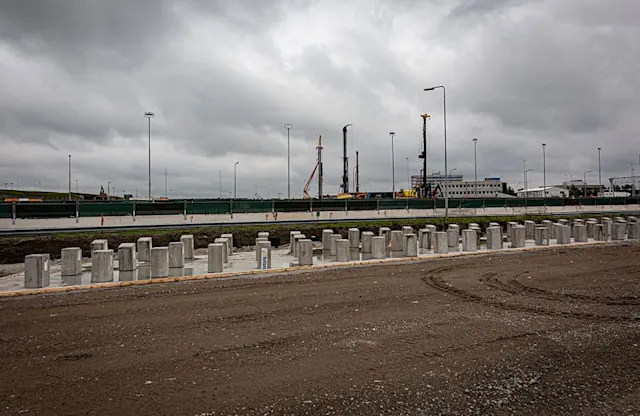
On 16th September, the first pile of the second viaduct for aircraft over the A4 motorway was driven into the ground. This viaduct is necessary in order to complete the dual taxiway system around the Schiphol terminal area. We are currently laying the concrete foundations.
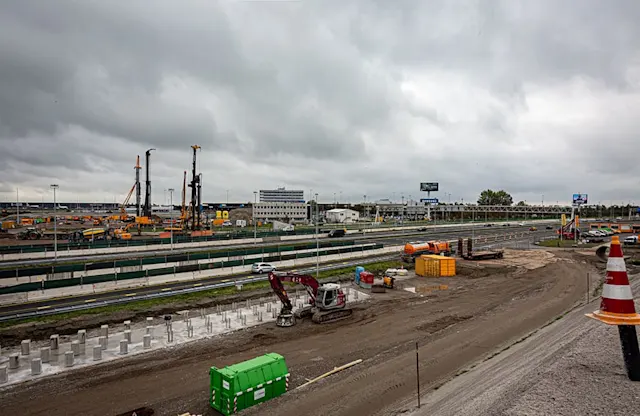
Schiphol is circled by a dual taxiway system. We use these dual taxiways to handle arriving and departing aircraft as efficiently as possible. However, the circle is not fully complete. Aircraft only have one lane to taxi on between the Kaagbaan Runway and the Zwanenburgbaan Runway: Quebec. This isn’t very practical, which is why we’re now turning Quebec into a dual taxiway. This entails, among other things, making a second viaduct for aircraft across the A4 motorway.
32 million kilos
In order to support the weight of both aircraft and the viaduct itself, the foundations need to be strong. The viaduct is 250 metres wide and 60 metres long. And the construction weighs no less than 32 million kilos. This, along with the weight of the planes, requires very sturdy foundations, which is why 900 piles are going to be driven into the ground.
Large cast
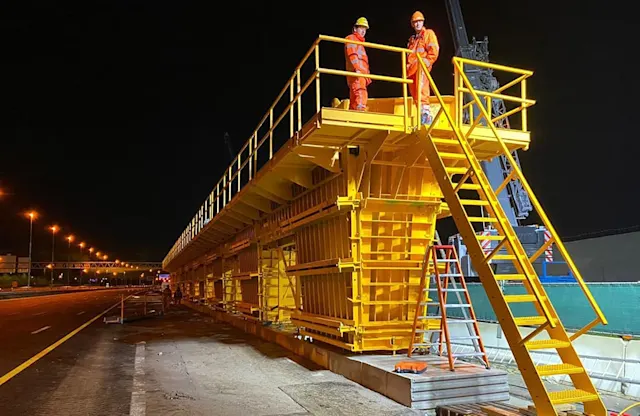
We’re currently laying the concrete foundations. How? First, the formwork for the foundations are made. This is done using a large cast, which is positioned and then filled with reinforcements and concrete. It takes a week for this to harden. Afterwards, the formwork is removed and the concrete foundations are left behind. In order for the viaduct to be well-supported by the foundations, the formwork must be installed at various points across the construction.
Closures Schiphol entrance and exit (A4)
In order for the works on the viaduct to be carried out safely, it is necessary to occasionally close the entrances and exits to and from Schiphol. The works will be carried out in the evening and at night so as to minimise inconvenience to road users.
- From 21:00 on Friday 23rd October to 05:00 on Monday 26th October, the entrance on the A4 from Schiphol to The Hague will be closed. Road users will be diverted via the A4, A9 and A5, and should bear in mind that the journey will take an extra 10 minutes.
- From 21:00 on Friday 30th October to 05:00 on Monday 2nd November, the Schiphol exit on the A4 from the direction of The Hague will be closed. Road users will be diverted via the A9 and A5, and should bear in mind that the journey will take an extra 10 minutes.
- From 21:00 on Friday 13th November to 05:00 on Monday 16th November, the Schiphol exit on the A4 from the direction of The Hague will be closed. Road users will be diverted via the A9 and A5, and should bear in mind that the journey will take an extra 10 minutes.