Blog · 12 November 2025 A.R.C: Pioneering Autonomous GPU Connection for a Sustainable Future
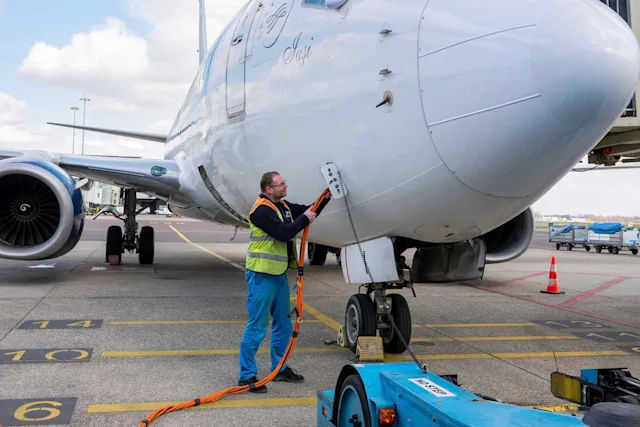
Airports are the beating hearts of global mobility, but behind every smooth arrival and departure lies a complex choreography of ground operations. One critical step is connecting aircraft to ground power units (GPUs) during docking—a process that, until now, has relied on human intervention. At Amsterdam Airport Schiphol, a bold new chapter is unfolding: the development of ARC (Autonomous Robot for GPU Connection), a technology that could redefine how airports operate, making aviation more efficient, sustainable, and future-proof.
The Problem: Bottlenecks and Environmental Impact
Connecting an aircraft to ground power is essential for maintaining onboard systems while engines and auxiliary power units (APUs) are shut down. Traditionally, ground-handling staff perform this task, but airports worldwide face chronic staff shortages and high physical demands. These challenges can lead to delays, forcing aircraft to idle and burn fuel unnecessarily—resulting in avoidable emissions and reduced operational performance.
The physical strain of manually handling heavy cables and operating access panels also contributes to workforce attrition, compounding the problem. Schiphol’s innovation team recognized that automating this process could not only improve efficiency but also create a healthier work environment and reduce aviation’s environmental footprint. It is also part of the bigger initiative called seamless inbound flow that aims at automating the entire docking power.
The Solution: ARC – Autonomous Robot for GPU Connection
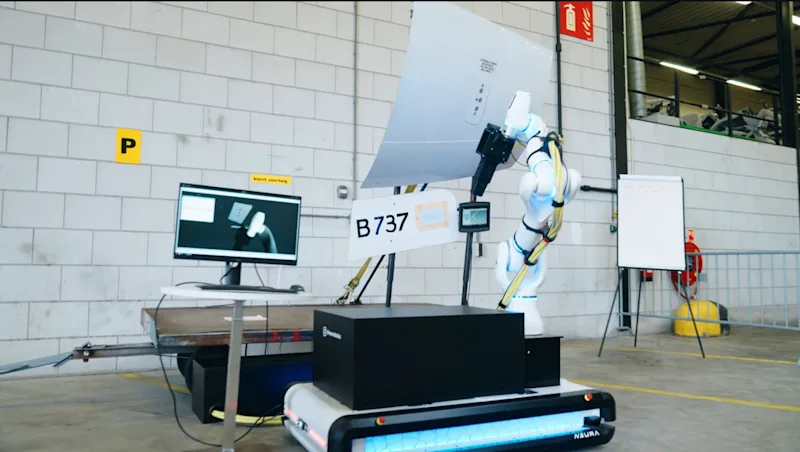
A collaborative innovation between Schiphol, KLM and NEURA Robotics. A.R.C (Autonomous robot for GPU connecting) is developed with borrowed components of already existing technology to validate the riskiest assumptions such as;
- Cable Handling: Picking up and draging the heavy power cable from its station to the aircraft.
- Navigation: Using lidar, can the robot navigate on the busy apron, avoiding obstacles and positioning itself precisely at the aircraft’s access panel.
- Panel Operation: Aircraft access panels are often secured with multiple buttons. ARC’s gripper, equipped with a computer vision system, identifies the correct panel and uses a custom-designed “pricker” with suction technology to press buttons and fully open the panel.
- Connection: ARC then inserts the cable into the socket, completing the connection without human intervention.
This process required overcoming significant technical hurdles. For example, the cable’s position in the robot’s safety zone initially prevented movement. The team solved this by mounting the cable from a height, creating a parabola that kept it outside the safety zone, allowing ARC to move freely while dragging the cable.
Why NEURA Robotics?
NEURA Robotics, based in Germany, is a pioneer in cognitive robotics—machines that can see, hear, and sense touch, learning from each autonomous operation. Their expertise was instrumental in developing ARC’s advanced capabilities, particularly in handling the nuanced, multi-step process of GPU connection. NEURA’s innovative approach to use existing proven technology to quickly validate risky assumptions as well as work simultaneously across various domains like Ai, Navigation, software, mobility and engineering gave us the confidence to choose them as the preferred supplier for this proof of technology.
Final Outcomes: From Demo to Global Collaboration
The recent live demo at Schiphol brought together stakeholders, global partners, airports, airlines, and ground handlers. The response was overwhelmingly positive, validating the business case for scaling up A.R.C and similar technologies. Schiphol is now looking to further develop this technology.
Call to Action: Join the Innovation Journey
Schiphol’s innovation team is inviting global innovators, ecosystem partners, and visionary collaborators to join the next phase of this journey. If you missed the demo, webinars will be held in December and January to showcase A.R.C and discuss further opportunities.
Together, we can make aviation future-proof—reducing environmental impact, improving operational performance, and creating healthier workplaces.