Blog · 2 October 2025 How can you best reach passengers who are at risk of missing their connection?
In 2024, Frankfurt Airport launched a pilot to provide Short-Connection Passes for time-critical transfers. Passengers can retrieve the digital pass via the short connection module of Travor, a passenger experience platform. QR codes are visible at strategic locations in the terminal, which arriving passengers can scan. But how do you ensure passengers take action to retrieve their pass, to help them ensure to make it to their connecting flight on time? The team at Fraport has done extensive testing with where to place the QR codes, and what text to use to figure out how to best reach the passengers. In an interview with Stefan Widauer, Innovation Lead at FraAlliance, and Cindy Bartschies, Designer at Fraport, they share their discoveries.
In short
- Passengers are not receptive while on the go, you reach them when they need to wait or need to make decisions.
- Personal expectations can vary widely from reality, extensive testing gives clarity on what works and what doesn’t.
- Travor adds value to both passengers in a hurry, and passengers with time to spare.
Keep it simple
One key takeaway is the importance of simplicity in design, especially in environments like airport terminals where users are often under pressure. Passengers may be navigating unfamiliar spaces while managing stress, fatigue, or tight schedules. In such situations, cognitive overload becomes a real concern. That’s why the team prioritised a design approach rooted in clarity and ease of use. By maintaining a familiar layout and consistent orientation, reducing text to only what’s essential, and emphasising a single, clear call to action, the design helps passengers make quick decisions with minimal effort. The goal was to create an intuitive experience that supports users without requiring them to stop and think.
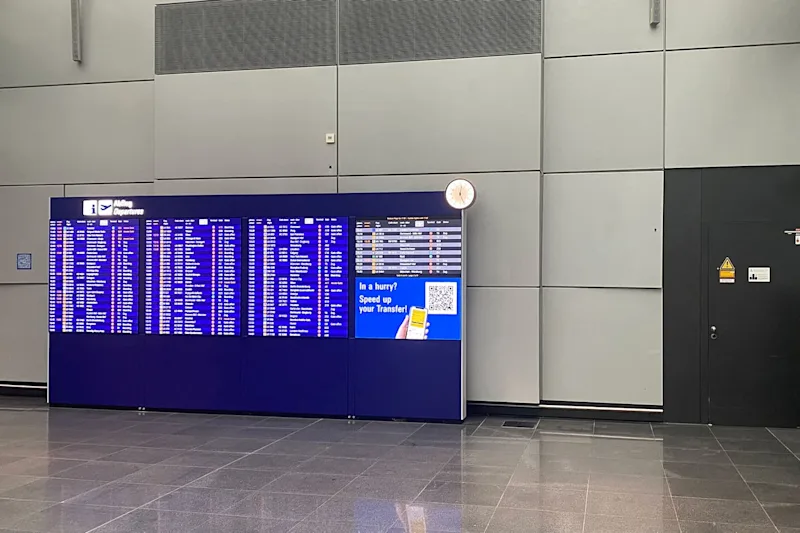
Fraport tested many QR code formats and one of them were small QR code stickers which were added to FIDs (Flight Information Displays). What they found was that small stickers were not effective at all. Passengers didn’t notice them from where they were standing. Printing and placing bigger stickers improved scan rates. However, the big improvement came when the team displayed a QR code on the actual screen itself. Bartschies explains: “The assumption is that people trust this more than a QR code anyone could have placed. Putting the QR code on a screen immediately makes it official and scan rates increased significantly. An added benefit is that messaging can be easily updated on a screen, testing becomes very quick and straightforward.”
Place QR codes at places where people have to do something
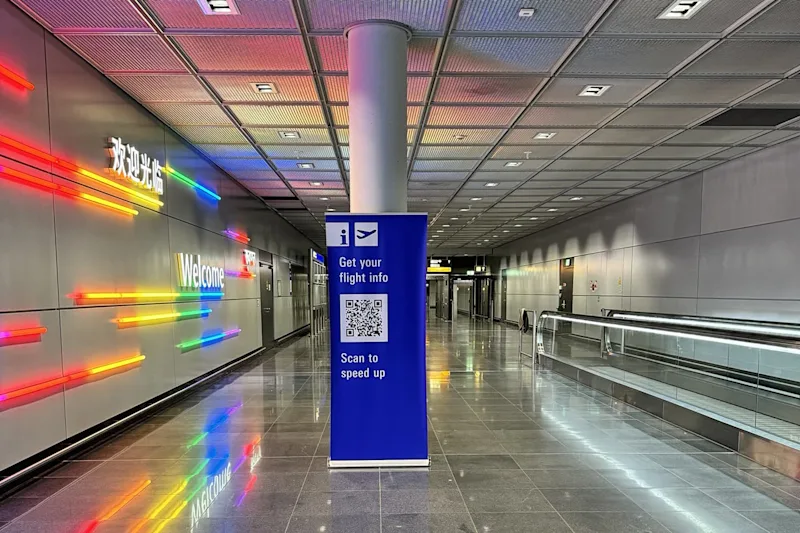
“After we learned that the pull-up banners work well, we ran another experiment. We took two banners and put them both in this long hallway. We placed them right next to the moving walkway. And since we placed two, they were very visible. We said to ourselves: Yes, this is perfect, this is how the setup should be. And afterwards, we looked at the results with a lot of anticipation. They were hardly scanned, scan rates went down drastically. This didn’t work.”, shares Widauer.
Bartschies explains: “No one scanned it, people just walk past. They're still looking for their flights. They want to get to those familiar monitors, to pause and look for information. They are not receptive while they are on the go. That’s when we started to focus on placing QR codes at strategic location where passengers need to make a decision, look up information, or wait. Examples of these are at FIDs and at security .”
Tailor messaging based on location (speed up / get flight info)
itinerary, to see where they need to go and how much time they have. This lowers a passenger’s anxiety level and makes them enjoy the airport more. Passengers who are in a hurry, to make it to their connecting flight on time, can retrieve the Short-Connection Pass.
What Widauer and Bartschies have done is to tailor the messaging for each type of passenger.
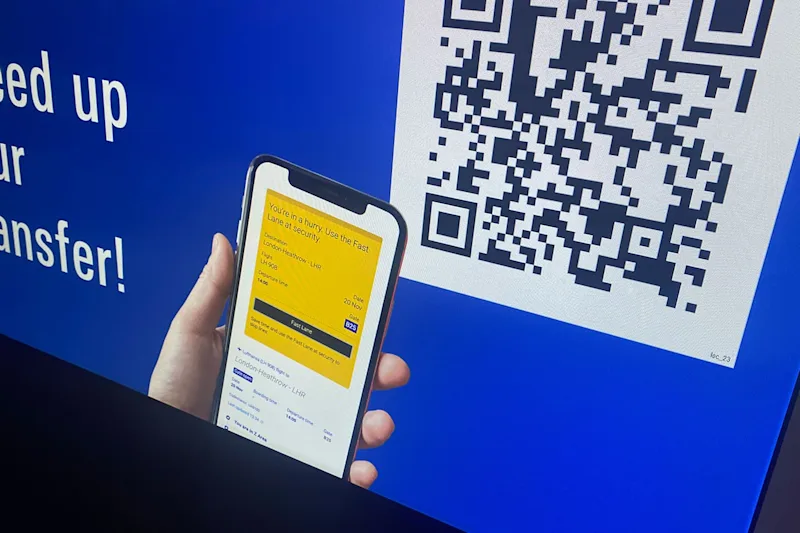
Widauer explains: “When passengers check their flight information on a FID before they have reached security, they might see that they have 30 minutes left and that could be enough if there are no waiting times. And from those places in the terminal, you can’t always see the queues so passengers think they will easily make it. But once they see people queuing then they are like, ‘Oh no, I’m not going to make it’. Getting a priority pass through Travor is then a big relief and the messaging ‘In a hurry?’ is very relevant at that location.
Fraport also tested with different headlines to test which ones lead to a better usage, e.g. Speed up your transfer, Get your flight info, and Check your connection time. Tests confirmed that different headlines impacts usage.
Widauer concludes: “And, location-wise it makes a lot of sense to adjust the call to action accordingly.”
Measuring to the teeth
What’s clear during the interview with Bartschies and Widauer is their commitment and focus to continuously improve. Every week, they analyse the current setup, analyse the data and make adjustments for the next iteration. Week after week.
Bartschies explains: “We worked with roughly 25 Travor QR codes and experimented extensively. We adjusted positions, headlines and mediums and we’ve logged all the data meticulously. You need to, otherwise, it will get chaotic, quickly.”
“We’re analysing weekly from Thursday to Wednesday, and we change the setups on Thursdays. We analyse the number of passengers walking thought the various areas, we calculate the passengers coming from the SkyLine people mover, and other merging passenger flows. That way, we are pretty accurate in understand the number of scans per passenger. We’re dealing with about 15.000 passengers per week”, adds Widauer.
Future plans
While the team have done extensive testing, running new experiments every week, they are not done yet. Widauer: “We’d like to consider multilingual options to cater to international passengers. This can improve conversion rates. And, we have some additional ideas on different messages based on passenger location and urgency.
We’re seeing that with Travor, we can help both passengers who are in a hurry a who are not. Time-critical passengers are often frustrated and the ones with a big problem. They are the ones that cost a lot of money when they miss their flight and have to be rebooked at hotels, receive compensation, etc. So, obviously having Travor to reduce this percentage is important. At the same time, having a digital channel for passengers who are not in a rush makes a lot of sense as well.”
Note: If you’re curious about the possibilities of Travor at your airport, request a demo.
Subscribe to Aviation Solutions updates:
Discover what we're up to and receive a quarterly digest of everything related to Aviation Solutions.