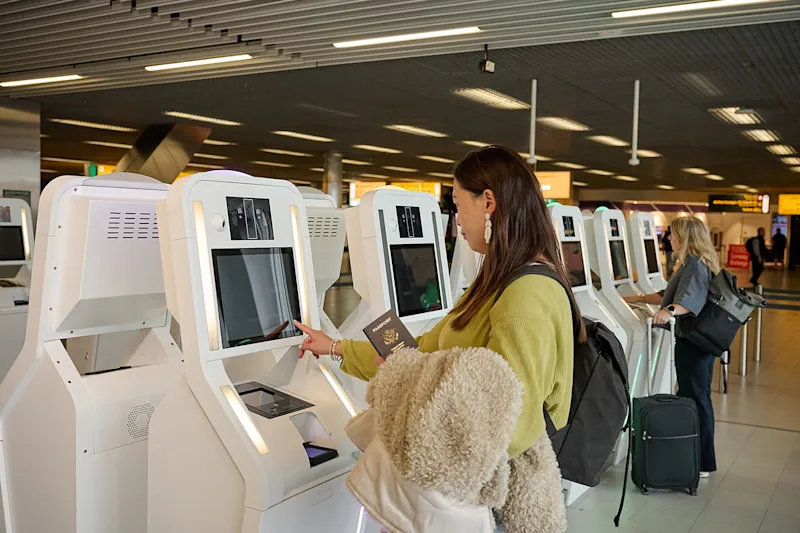
On 12 October, Europe will launch the digital Entry/Exit System (EES). This new registration system for non-EU nationals travelling to a Schengen country for a short stay will gradually replace passport stamping. The rollout will take place in phases over a six-month period. In the Netherlands, the government will begin implementing EES on 12 October at two maritime border posts. Schiphol will follow from 3 November. In order to ensure that the introduction at Schiphol takes place in a controlled manner, we have agreed on a phasing with the government to gradually expand to 100% EES registration.
Starting on 12 October 2025, the Netherlands will begin phased implementation of the Entry/Exit System (EES) at two maritime border posts: Eemshaven and IJmuiden/Amsterdam Port. These smaller border posts have been selected to gain initial experience with EES and to ensure a safe and controlled introduction. The Netherlands will follow a pre-defined step-by-step plan to achieve full EES deployment at all border posts within six months. After Eemshaven and IJmuiden/Amsterdam Port, other maritime border posts and smaller airports will be added gradually.
The Netherlands is expected to begin small-scale EES operations at Schiphol on 3 November 2025. Schiphol is the country’s largest border post, handling the highest number of travellers from outside the Schengen area. From early December, operations will be scaled up, with the first milestone being the activation of EES at the initial arrival filter.
During the phased rollout from 12 October 2025 to 9 April 2026, there will be differences between border posts: some will have full EES functionality, others partial, and some will not yet have started. The Dutch government is currently finalising the rollout plan in collaboration with all chain partners. This plan will be submitted to the European Commission by 24 September 2025 at the latest. It will outline the agreements made regarding the phased implementation of EES at each border post.
At Schiphol, we will begin on 3 November with small-scale registration at various filters, outside peak hours. The plan is to then start at Arrival Filter 1 and upstream location D1. If this goes smoothly, we will gradually expand to other arrival filters and upstream locations. The Non-Schengen/Schengen filter will be the last to be included, as it is the most time-sensitive.
From 3 November, a small number of travellers holding a non-EU passport will be registered in the EES upon arrival in the Schengen area. The number of registrations will gradually increase as more arrival filters and upstream locations are brought into use for EES.
The EU launched a campaign on EES this week. Flyers and posters are available, as well as an infographic via the EU website.