Blog · 23 april 2025 From hesitant to essential: Two years Deep Turnaround at Menzies Aviation
"I can't imagine working without Deep Turnaround anymore," says Hasan Aydogdu of Menzies Aviation. Two years ago, the ground handler started using the system, and its impact on operations quickly became evident.
But a new tool meant a new way of working, and some colleagues were hesitant to use it. Fast forward to today, and those doubts are long gone. Deep Turnaround is fully integrated and an essential part of daily operations.
We spoke with Menzies Aviation about what changed, and how they currently use
Deep Turnaround on a daily basis.
In short
Menzies Aviation fully integrated Deep Turnaround into daily operations which make turnaround management faster and more precise.
Real-time data and improved TOBT tracking have reduced manual work and guesswork.
Expanded camera coverage, and new features like historic data and automatic timestamping continue to enhance efficiency.
From educated guesses to precise decisions
Menzies Aviation is one of the world’s largest ground handling companies and manages aircraft turnarounds at over 200 airports. Their responsibilities range from baggage handling and aircraft refueling to pushback operations and coordinating the various teams involved in the turnaround process. At Amsterdam Airport Schiphol, Menzies Aviation uses Deep Turnaround to streamline operations.
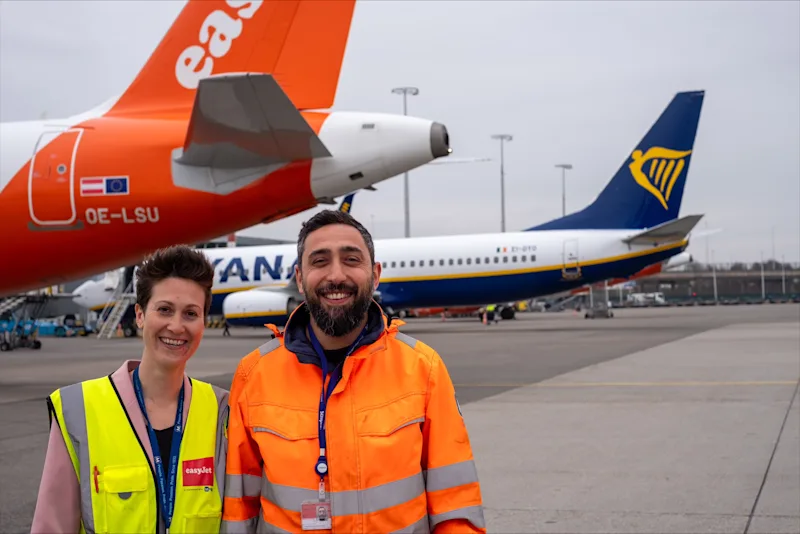
"Our job is to get an aircraft ready for departure as safely and efficiently as possible," says Laura Buying, Service Delivery Manager at Menzies Aviation. She oversees ground handling coordination and airline communication.
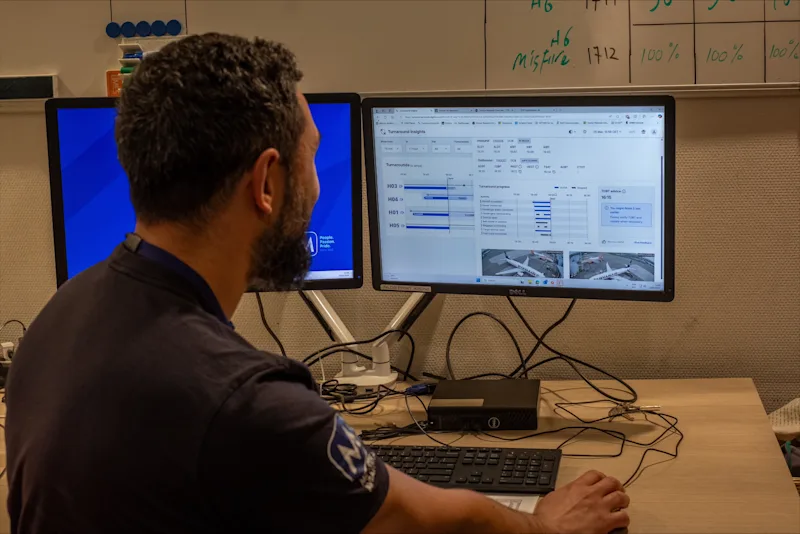
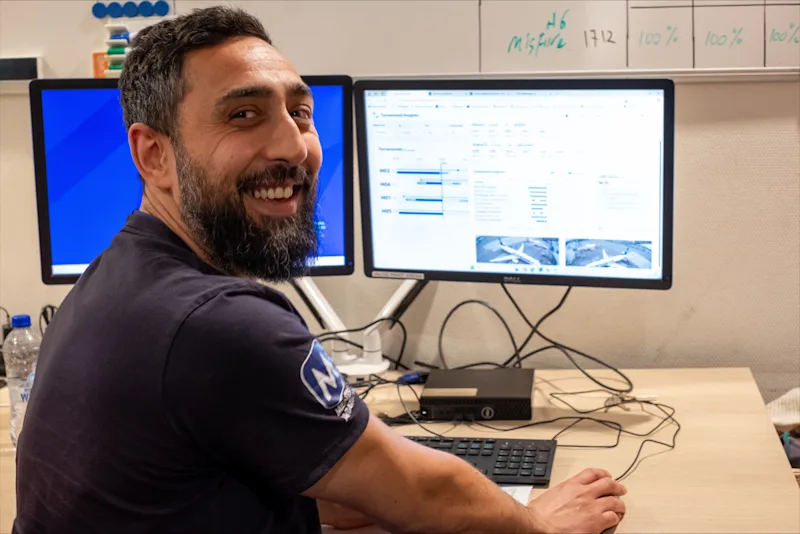
One of the key figures in this process is Hasan Aydogdu, Flight Watch Aircraft Control at Menzies Aviation. From his office near the platform, he monitors multiple screens, tracking arriving and departing flights simultaneously. His job is to make sure that the right people are in the right place at the right time.
"My work is all about constant adjustments," Aydogdu explains. "I have to set priorities and make real-time decisions. In the past, we had to manually check and call around to determine how far along an aircraft was in the turnaround process. That took time and was often based on estimates. Guesswork essentially."
That’s why two years ago, Menzies Aviation decided to start using Deep Turnaround, an AI-driven turnaround monitoring tool from Aviation Solutions by Schiphol Group. It provides real-time and predictive data to optimise the turnaround process. Now, Aydogdu and his team can instantly see the status of an aircraft’s turnaround. What’s already completed? And more importantly, what still needs to happen before departure?
“At the core of our operations plan”
For most colleagues at Menzies Aviation, the benefits of Deep Turnaround quickly became clear. But not everyone was immediately convinced. "Some colleagues wondered, do we really need this?" she recalls. Some employees stuck to traditional methods such as handwritten lists and phone calls. "Now everyone follows a set procedure. Deep Turnaround is at the core of our operations plan". Aydogdu agrees: "We can’t imagine working without it anymore"
So how did this new workflow change the daily operations?
A year ago, Menzies Aviation still relied on manually estimated Target Off-Block Times (TOBT), which was only 60 to 65 percent accurate in 2023. By using Deep Turnaround’s predictions Menzies Aviation was able to increase the turnaround punctuality from 67% in 2023 to 76% in 2024 and that percentage continues to climb in 2025 Recent numbers show a turnaround punctuality of 78%.
"We need to rely on this more," Buying said back then. And that’s exactly what happened. Over the past year, Menzies Aviation has fully integrated Deep Turnaround into its workflow. Buying made it a priority, and frankly, gave her team no other choice.
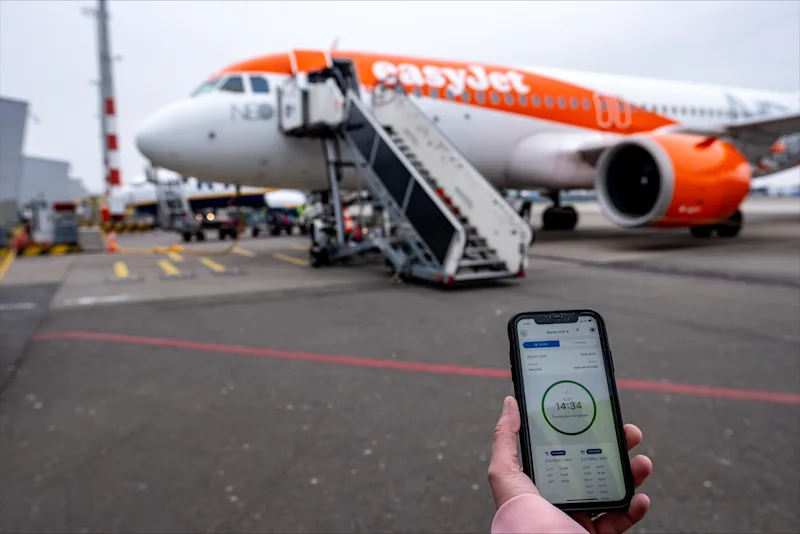
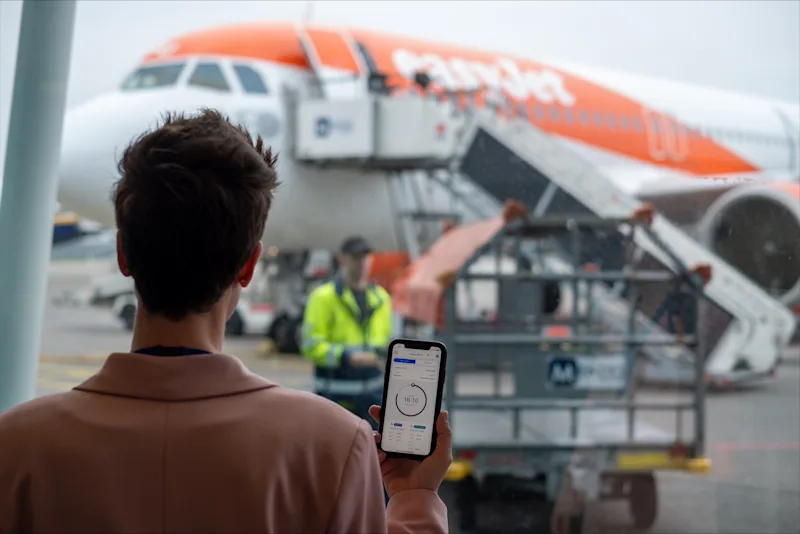
Alongside this shift in approach, a dedicated app for colleagues on the platform was developed to improve TOBT tracking and streamline updates.
"We used to communicate changes manually," Buying explains. “But Deep Turnaround saves us a lot of time and prevents miscommunication. I estimate we’ve reduced the number of calls with over 50%. We are even working on a feature that with a single click, we can update TOBT and make it immediately visible to all relevant parties.”
Small changes, big Impact
Like any other software program, daily usage exposes room for improvement. Many small refinements over the years add up, and have significantly improved Menzies Aviations’ daily operations.
"Previously, we’d get a simple message that an aircraft wasn’t ready. Okay, good to know, but what does that actually mean?" Buying explains. "Now, we get detailed status updates. Are we waiting for passengers? Is baggage still being loaded? Does refueling need to be completed? That extra clarity makes a big difference in our decision-making."
For example, if only the last few bags need to be loaded, the pushback team can be prepared instead of waiting for the entire process to finish. The system now also provides clear visual signals to indicate which teams are available and which tasks are still pending.
"These adjustments might seem small, but during peak operations, they make all the difference," says Buying. "We lose less time and can react faster."
More camera coverage
Although not a new feature, the expansion of Schiphol’s camera network has made Deep Turnaround even more effective. Cameras have been installed at most stands which makes Aydogdu’s job a lot easier.
"I can now check live footage of almost all the gates we operate and immediately see if and where a delay is happening. That makes a huge difference in how quickly we can respond," he says.
This is particularly useful in bad weather. "During a recent storm, we used the cameras and Deep Turnaround to immediately see that boarding was delayed. Before, we had to rely on calls and estimates. Now, we knew instantly and could decide whether to reassign a pushback crew.”
Towards full integration
"In the coming period, we’ll focus on making even better use of the system," says Buying.
One of the key developments last year was improving access to historical data. Deep Turnaround was initially designed as a real-time decision-making tool, but Menzies Aviation has discovered the value of looking back at past performance.
For Buying, this is especially useful when talking to airlines. "If we missed a TSAT (Target Start-Up Approval Time), we used to automatically take the blame," she explains. "Now, we can prove exactly what happened, like did we send the pushback late, or was the flight crew late with calling ready."
Buying used to take screenshots manually to save historical data, but a recent update allows for structured retrieval of past data.
Additionally, Buying is working on getting the timestamping data by Deep Turnaround to be automatically filled into Menzies Aviation’s system. Currently, some events like the start of boarding or the arrival of the fuel truck still have to be manually logged. This is time-consuming and leaves room for small inaccuracies.
"Airlines want to know exactly when certain actions happen," says Buying. "Right now, we enter that data manually, even though Deep Turnaround already collects it. By automating this, we’ll get even more precise data without extra work for ground teams."
Here to stay
Where Deep Turnaround was once seen as a useful tool by some but received with scepticism by others, it’s now become indispensable for everyone over at Menzies Aviation. With new features on the way and continuous refinements as a result of close collaboration with the development team, the question is no longer whether Deep Turnaround works, but how much more it can improve operations.
“The Deep Turnaround product team actively takes our feedback into account. We were closely involved in fine-tuning the dashboard, developing the app, and the history feature. It is amazing to see the platform evolve based on our input. It made a real difference in how we work", Buying explains.
I’m glad we’ve moved past the ‘do we really need this’ phase? If I suggested turning the system off for a day, I think we’d have a big problem,” she concludes.