Blog · 17 juni 2025 From endless calls to smooth operations: How Delta uses Deep Turnaround
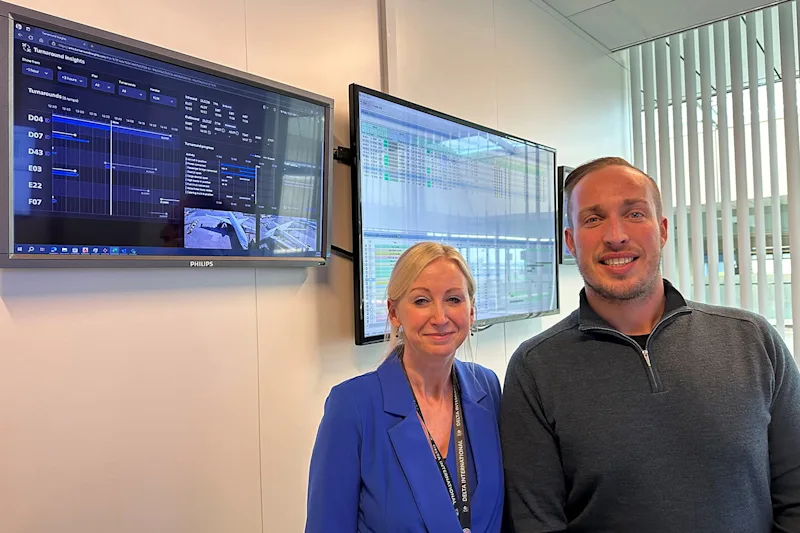
"If we removed Deep Turnaround today, we would be missing a crucial piece of the puzzle to ensure smooth operations. It makes our communication structure a lot more efficient", says Iris van den Berg, Tower Operations Service Manager at Delta Airlines.
In short
- Reliable information: Delta’s control tower at Schiphol used to rely on information from multiple teams and systems. Deep Turnaround adds a reliable source of accurate turnaround data, making coordination faster and easier.
- Proactive issue resolution: Live video feeds and AI-powered tracking help the team spot issues early, so they can fix problems before they cause disruptions.
- Improved coordination: Since using Deep Turnaround, Delta has cut unnecessary calls by 50 percent and improved coordination and helped them earn ‘Hub of the Year.’
The challenge of managing operations at Schiphol
Managing operations at Schiphol isn’t easy. Flights are constantly arriving and departing, multiple ground handling partners are involved, and everything runs on tight schedules. A smooth turnaround depends on solid coordination between all parties, requiring accurate information at all times. But before Deep Turnaround was available, that required a lot of communication.
At the time, a single operation manager could be responsible for coordinating up to 22 flights at once, spread across multiple piers. Communication relied heavily on phone calls and rough estimates.
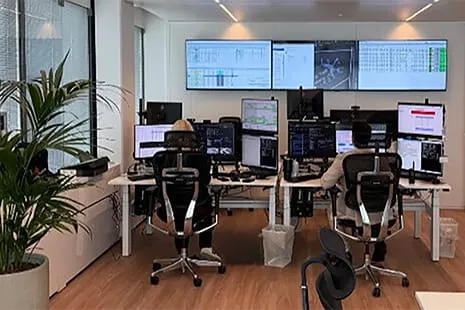
In Atlanta, Delta already operated domestic control tower domestically ensure safe and efficient arrivals and departures. This inspired Delta in 2019 to set up the same for EMEA, and created its own control tower at Amsterdam Airport Schiphol to centralise operations and improve control. While this was a major step forward, one challenge remained: a lack of real-time visibility into what was actually happening on the ground. That’s where Deep Turnaround made the difference.
The missing piece: Real-time visibility
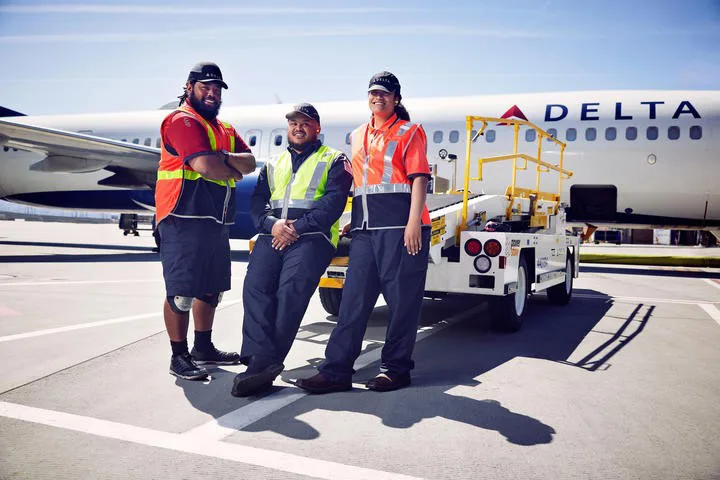
At its domestic hubs in the U.S., Delta has full control over its operational processes. Schiphol, however, presents a different challenge. Here, Delta works with a network of external partners, security teams, catering services, and fuel providers. Coordinating all these moving parts is no small task.
"Back in 2015, I would walk around the piers with a phone, coordinating all the flights. See, all external partners and stakeholders would call the same telephone number. That meant a lot of manual communication and no clear overview" says Iris, who was appointed in 2019 to set up Delta’s control tower at Schiphol.
To fix this, Delta needed a single coordination point. Both for its operations center in Atlanta and its partners at Schiphol.
"Normally, you'd have one person standing by a flight with a phone, being approached by a passenger while also receiving calls about twenty other flights about things like if loading has finished or if fuelling has already started. Now those phone calls are no longer needed," says Thijs Koning, Senior Tower Agent, and one of the tower’s first team members of Delta’s control tower in at AMS.
What was missing was a tool that provided real-time insights into the operation.
Delta’s Deep Turnaround journey
Two years ago, Delta connected with the Deep Turnaround team. The system offered a promising AI-powered solution to gain control over turnaround processes. But to make it work smoothly, Delta worked closely with the team to tailor it to their daily operations.
Two employees from the Deep Turnaround team regularly visited to brainstorm ideas and understand how we handle certain challenges. They saw us as a great test group for new features," says Thijs.
Through real-world feedback, Delta was actively contributing to Deep Turnaround’s development. And that paid off.
The ‘aha’ moment: Achieving real-time visibility
"At first, we had to rely on information through third-parties but, sometimes it’s crucial to see the real situation."
With a graphical overview of all turnaround events at the platform and live video feeds, the team can instantly see which processes are in progress and where delays are forming. 'When someone says the truck is on its way, I don’t just have to take their word for it anymore, I can actually check,' Iris explains.
No more communication overload; data driven decision making
Deep Turnaround is now a standard tool in Delta’s daily workflow. "About 30 minutes before departure, I check: How far along is the loading process? Is everything in the right place? Is there any equipment blocking the aircraft? How many containers are already on the platform? Is security in position?" explains Thijs.
These checks allow the team to step in early if a delay is developing. The AI timeline is used not only in real time but also for post-flight analysis. "We use live footage during operations, but the AI timeline is crucial for reviewing what happened afterward," says Thijs.
Since implementing Deep Turnaround, communication has become more efficient. "Before, an operator could get up to 150 calls per shift. Now, that number has been cut in half," says Iris.
The system also helps correct inaccurate status updates. "A partner’s system might show that the pushback truck has arrived, but when we check Deep Turnaround, it’s clear that it hasn’t. That’s because the truck marked itself as ‘on the way,’ but in reality, it’s still driving over from the E or F pier. That small timing difference can be the reason we need to push TOBT back by five minutes."
With objective data, Delta can now make more accurate calls on whether a flight is truly ready for departure. "Before, we had to rely on what people told us, and sometimes that led to miscommunication. Now, we can see it for ourselves. Our decisions are based on facts, and that makes all the difference," says Iris.
Delta's improvements did not go unnoticed. This year, DL HUB AMS was named station of the year, recognising its operational performance. While it’s difficult to isolate the exact impact of Deep Turnaround, the team agrees it played a significant role in optimising processes and improving on-time performance.
What’s next: Expanding Deep Turnaround capabilities
Delta is looking to further optimise Deep Turnaround and expand its capabilities. One of the main goals is to dive into the history of Delta’s turnarounds, more.
"We have a huge amount of data available through Deep Turnaround, but we’re still figuring out how to make the most of it. Analysing trends automatically over longer periods will be very beneficial," says Thijs.
The Deep Turnaround team has proven to be a great development partner, always learning from Delta's processes and finding ways to add value. For example, Delta sees even more ways AI can help, like automatically spotting safety hazards on the ramp, such as oil spills or misplaced equipment. As the system continuously expands its capabilities, it’s becoming an even bigger part of daily operations.
"It’s no longer a question of ‘Do we need Deep Turnaround?’ If we turned it off tomorrow, we’d lose important insights to run our operations with," concludes Iris.
Note: Deep Turnaround is implemented at, and supporting, multiple airports. If your airport is also looking for ways to improve turnaround operations through insights and collaboration, please request a Deep Turnaround demonstration.
Subscribe to Aviation Solutions updates:
Discover what we're up to and receive a quarterly digest of everything related to Aviation Solutions.