What is grid congestion?
Grid congestion and transport limitation
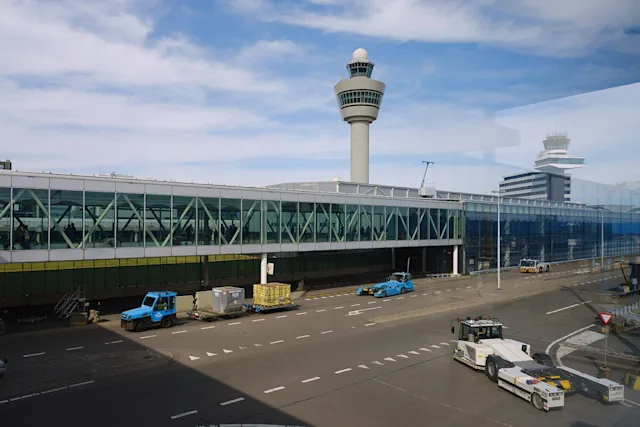
The growing demand for electricity in the Netherlands is causing bottlenecks in national and regional grids. This leads to grid congestion, meaning the demand for electricity exceeds the available supply. The national and regional electricity networks become overloaded. Schiphol Utilities is also experiencing bottlenecks, and there is currently grid congestion on our network.
Due to the expansion of business activities in the area, we receive many requests for electrical capacity. This growth, combined with the acceleration of the energy transition, is increasing the demand for electricity. Transport capacity demand is rising due to new construction, replacing gas-fired boilers with electric heat pumps, and the growing need for charging electric vehicles. As a result, the demand for electrical capacity exceeds the available supply.
As a grid operator, we are responsible for the availability, reliability, and affordability of the electricity network. To safeguard safety and availability, a temporary transport limitation has been in effect since 2023. In short, this means:
Requests for new connections and/or increases in transport capacity are currently being denied. If the requested capacity exceeds the available transport capacity, it could lead to grid failure and/or damage to the electricity network. Therefore, it is crucial that connected companies do not exceed their contracted transport capacity. See the tips below on how to reduce your energy consumption.
You can still use the capacity stated in your contract, maintaining your right to access the electricity network and the contracted transport capacity. This will only be reduced if, for example, simultaneous demand shifts cause network overload or failure. The same applies to energy fed back into the grid: you may not feed back more than what is stated in your contract.
Due to the current situation on the electricity grid, we can no longer accommodate large projects on an ad-hoc basis. Therefore, requests for new connections or increases in contract capacity are processed in the order they are received. The longer you’re on the waiting list, the sooner you’ll be helped. This helps us prevent bottlenecks and issues. When you submit a request, you’ll be placed on a waiting list, giving you priority later. You’ll receive a letter once we know when energy delivery can resume.
To prevent problems, we ask all users to submit a ten-year forecast annually. This helps us plan targeted adjustments and expansions. By being informed in advance about expansion plans or growing capacity needs, we can identify and resolve bottlenecks. It’s important to notify Schiphol Utilities in time about your expansion plans and expected capacity needs.
We expect the developments of the energy transition to accelerate in the coming period. These developments cause higher peak loads. That’s why we ask our customers to save energy wherever possible.
You can view your energy consumption and the transport capacity used by your electricity connection(s) using the Schiphol smart energy dashboard. You can request access to your energy and water usage via our website – see the link below.
A new policy requires consumers to submit a capacity request to increase their contracted transport capacity. Capacity is no longer automatically increased when exceeded. We first assess whether there is sufficient transport capacity to keep the grid safe and prevent outages.
We are building additional high-voltage stations, distribution stations, and replacing all cables at Schiphol to strengthen the network. We expect the new high-voltage stations at Schiphol-Centre and South-East to be operational by the end of 2027. Until then, this means you may have to wait longer than usual for a new connection. The transport limitation is expected to be lifted once the stations are operational in 2027.
In addition to the new high-voltage stations, Schiphol is investing in expanding the electricity grid to eliminate bottlenecks in transport capacity at distribution stations and in cables. Where necessary and efficient, we are also reorganising connections to meet transport capacity demands in specific parts of the grid.
Schiphol Utilities is increasing transport capacity at various points in the network. We are installing new distribution stations and optimally distributing consumers across current and future stations. We are also increasing the capacity of intake stations in collaboration with the public grid operator. Additionally, we are exploring how to make optimal use of available transport capacity, such as spreading power demand and utilising storage capacity.
Read the answers to frequently asked questions about grid congestion and transport restrictions below. Do you have any other questions? Feel free to contact us at utilityservices@schiphol.nl.