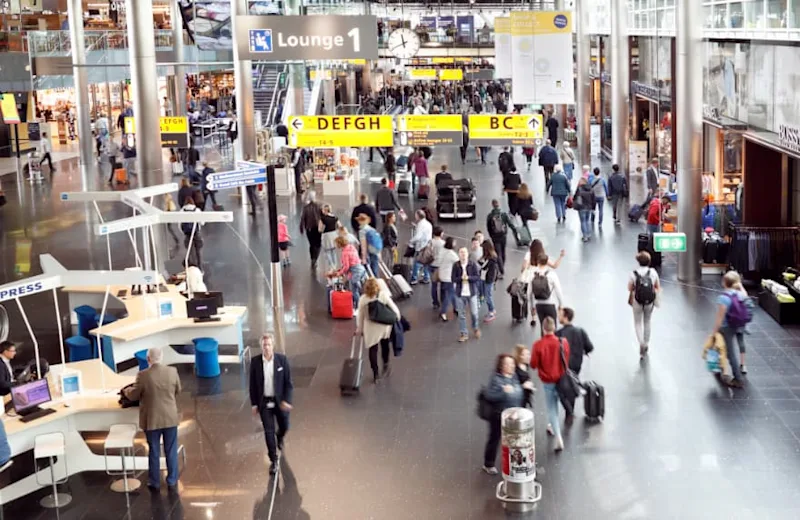
Connecting the Netherlands optimally with the rest of the world, thereby creating social and economic value. That is Schiphol's mission. There’s no doubt about it; the extensive network of destinations contributes to our well-being and our prosperity. So how does that work?
Just imagine the Netherlands circa 1920. A country based on a series of social, religious and ideological pillars, where women have recently won the right to vote and the very first cars are on the roads. It’s connected to neighbouring countries by road and by seaports. If you wanted to travel, to Istanbul for example, it was an enormous enterprise that took several days. A century later, you can board the aircraft and, with a little luck, you could be queuing at the Hagia Sophia just 4 hours later.
A world without flying is now difficult to imagine. For many people in the Netherlands, it makes it easier to explore undiscovered places. Seeking out the sun in the winter. Or visiting family and friends in far-off places. Air travel links us to the rest of the world, boosts our wellbeing and happiness and expands our knowledge of other cultures.
When it comes to connectivity, Schiphol is among the best in Europe. This means that we in the Netherlands are very well connected with the rest of the world, and the rest of the world with us. It’s quite an achievement for a relatively small country. So how is it possible? Schiphol serves as a hub, where many passengers transfer to reach their destination.
Schiphol and its role as a hub mean more for the Netherlands than just convenient holiday flights. All of these connections and flights give a major boost to our economy and prosperity. Although the Netherlands is not among the largest economies in the world, we are among the top export countries and countries with the most foreign investors. What’s more, Schiphol makes a significant contribution to the gross national product (GNP) and directly and indirectly provides hundreds of thousands of jobs. Schiphol keeps the Netherlands moving and makes a small country great.
At the same time, demand for air travel is increasing. This is because the economy is growing. The more money we have to spend, the more holiday flights we take. When business is booming, the number of business trips rises. But Schiphol cannot simply grow forever.
It is essential to take account of the negative impact of air travel. Both locally, for neighbours who are affected by noise nuisance and impaired air quality, and globally, because of the influence on climate change. That is why we are mindful of our environment and society. In the coming years, we will work to build broad support for aviation, focus on legal certainty for all parties, and be publicly and transparently accountable.