News · 26 June 2025 Start of works for PFAS soil treatment facility
At the end of May 2025, the permit for the soil treatment facility next to the Zwanenburgbaan Runway was finalised. With the soil treatment facility, Schiphol intends to clean the PFAS-containing soil that is currently in storage facilities (the TTOPs). The soil comes from (construction) projects at Schiphol and has become polluted as a result of PFAS-containing firefighting foam that was used in the past. In early July 2025, we will start work on TTOP5 for the construction of the soil treatment facility.
Works TTOP5
We will start by widening the access road to TTOP5 and laying a slab track. We are also installing return drainage to control groundwater levels. We plan to lay a concrete floor after the summer. Next year, we will start construction of the soil treatment facility itself. We expect to start operating the facility in the third quarter of 2026.
How does the soil treatment facility work?
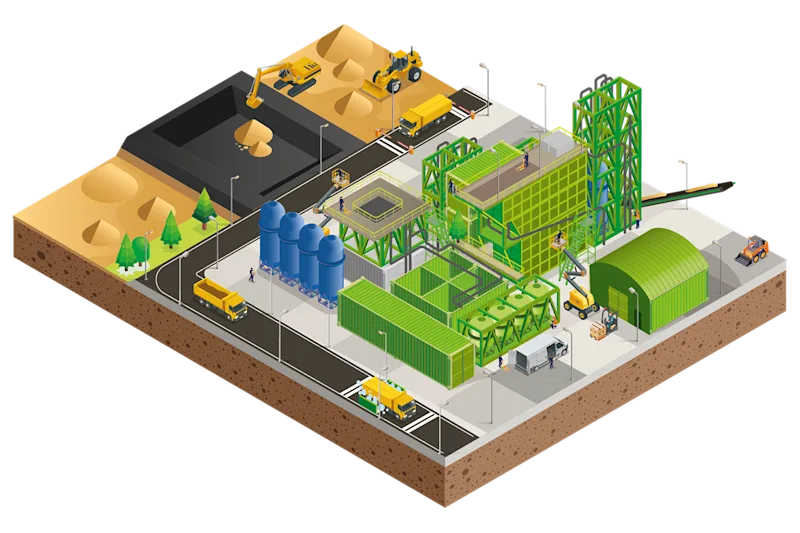
The soil treatment facility will be located at storage facility number 5 (TTOP5). It will clean the PFAS-containing soil at the storage facilities in about 3 to 4 years. As a result of the cleaning process, 80% comes out as clean sand, which we can reuse at Schiphol.
The soil treatment facility uses a proven technique, in which the PFAS dissolves in water, which is then purified by activated carbon filters. Such facilities are already in place in Belgium, and one is currently being built in Den Helder.
Bricks in Doetinchem
Besides the clean reusable sand, polluted residual sludge (the remaining 20%) is produced at the facility. We could dispose of that to an authorised processor, but then the PFAS would not disappear from the environment. We are hopeful that we can bake bricks from this sludge. We already did some small-scale tests with start-up Claybens two years ago and the results were positive. Schiphol is not the only party working on this. Recently, the municipality of Doetinchem, together with Claybens, reached a milestone by baking 50,000 bricks from PFAS-containing soil.