From a runway in a field to an economic powerhouse
1916
Schiphol is a military airfield owned by the Dutch State. After the war, civil aviation at the airport begins to grow.

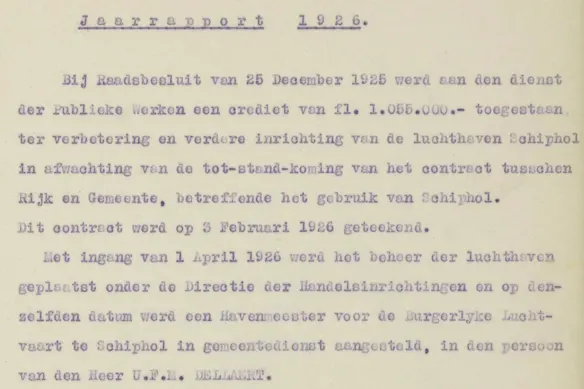
1926
Amsterdam City Council approves funding to upgrade the airport. On 1 April, the City of Amsterdam takes Schiphol over from the State.
1928
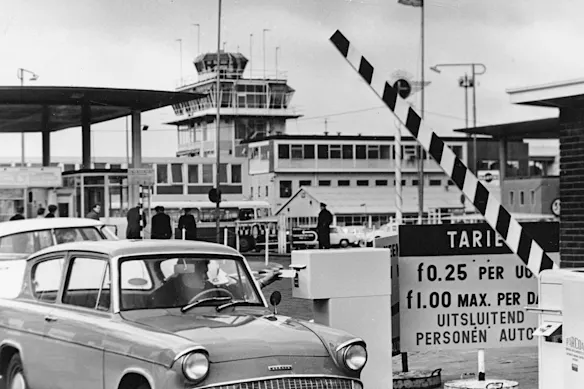
The new station building is designed in the Amsterdam School style by architect Albert Boeken and interior designer Ad Grimmon from the Public Works Department. It serves as a showcase for the city and the airport during the Olympic Games. The cauldron atop the Olympic Stadium’s tower is jokingly referred to as ‘the KLM pilots’ ashtray’.
1938
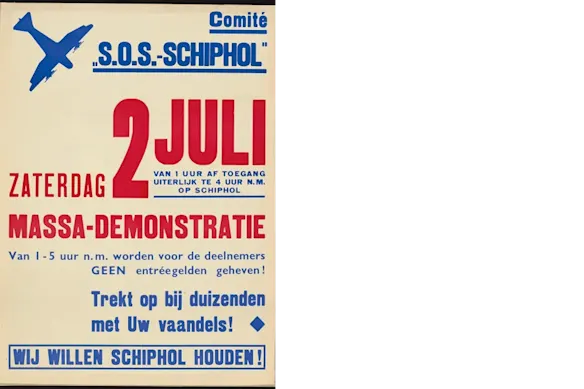
In the 1930s, the nationwide tug-of-war surrounding the national airport intensifies. For a moment, it seems as though Leiderdorp – conveniently situated within the Randstad – will be chosen as the location. That would mean the end of Schiphol. Soon, however, people take action to save the airport with S.O.S. Schiphol! By way of a demonstration and other action, locals make it clear that Schiphol must remain in its current location.
1949
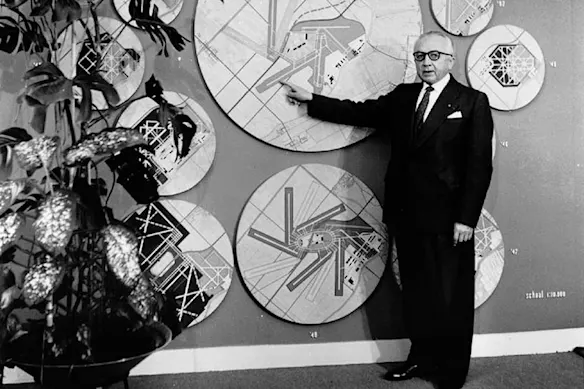
After the Second World War, Schiphol is destroyed. The airport remains open with all kinds of makeshift emergency buildings. In 1949, the government chooses Schiphol as the national airport. Airport manager Jan Dellaert – involved with the airport from the very beginning – travels the world in search of inspiration. He comes up with a plan for a tangential runway system, which is safer and more efficient than parallel runways.
1958
Luchthaven Schiphol NV is established with the State as shareholder, with a 65% stake in the airport. Amsterdam holds 34%, and Rotterdam 1% of the shares. This model of government bodies as (major) shareholders exists to this day, but with different share percentages.
1967
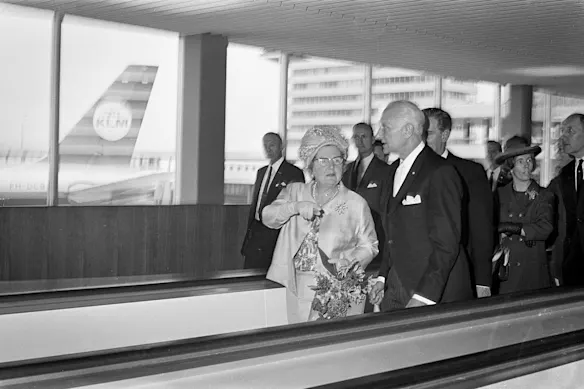
Queen Juliana opens the new terminal building. From that moment on, the original Schiphol is renamed Schiphol-Oost. The Amsterdam Public Works Department, consultancy firm NACO, architects Marius Duintjer and Frans de Weger, interior designer Kho Liang Ie and graphic designer Benno Wissing collaborate on this project.
The terminal is given a central position at the airport, with an arrivals hall on the ground floor and a departures hall on the first floor. Three piers are connected to four runways.
1989
Schiphol presents the Schiphol Master Plan 2003. Schiphol is to function as a mainport for Europe: a major logistics hub. The Netherlands positions itself as a gateway to the continent. The Port of Rotterdam is also designated as a mainport.
1997
The old station building from 1967 is partially demolished to make way for Schiphol Plaza. Schiphol starts to look more and more like a city: Airport City Schiphol. A city where not only flights take place, but where more offices and hotels establish themselves due to the excellent connections with the world. Schiphol Plaza is further developed into a top retail location where travellers, employees and visitors can shop.
2003
The Polderbaan is opened, Schiphol's fifth main runway. This location was chosen because the routes pass over the least densely populated areas. The Polderbaan becomes the most used runway, along with the Kaagbaan.
2006
Amsterdam City Council, as a shareholder, vetoes the privatisation of Schiphol. This had been decided by the government, but Amsterdam considers Schiphol ‘too important to hand over, even partially, to investors who pursue only profit maximisation.

2016
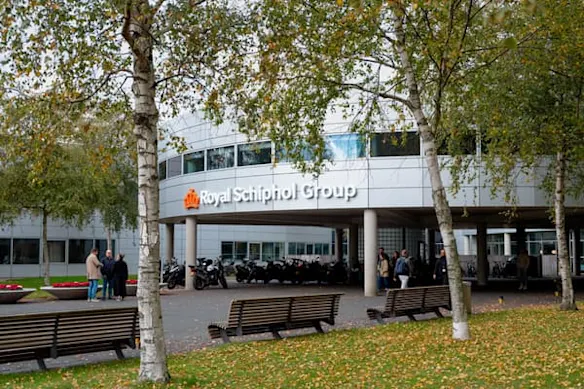
On 19 September 2016, Schiphol celebrates its 100th anniversary and receives the designation ‘Royal’ from King Willem-Alexander. This underscores the airport's long-standing distinguished reputation and importance to the Netherlands. Royal Schiphol Group gets a new logo incorporating a small crown.
2025
Schiphol presents a new Strategic Plan and investments of around €10 billion. These investments are intended to ensure higher quality for airlines, travellers and employees.
Maintaining a balance with the surrounding environment is central. Schiphol works on becoming quieter and more sustainable on the airport grounds and encourages airlines to switch to even quieter and more fuel-efficient aircraft through tariff differentiation.
With these new plans, Schiphol strives to maintain its important international network with many direct connections, in balance with the environment. Schiphol also continues to contribute to broad prosperity in the region and to the national economic interest.
The new Schiphol brand and logo are introduced.