From muddy field to international airport The history of Schiphol
Schiphol was founded in 1916 on a piece of land in Haarlemmermeer that had been reclaimed from the water. Thanks to courage and a pioneering spirit, the Netherlands’ national airport has grown over more than 100 years to become a home for world travellers.
100 years of Schiphol in 100 seconds
Once upon a time…
1916
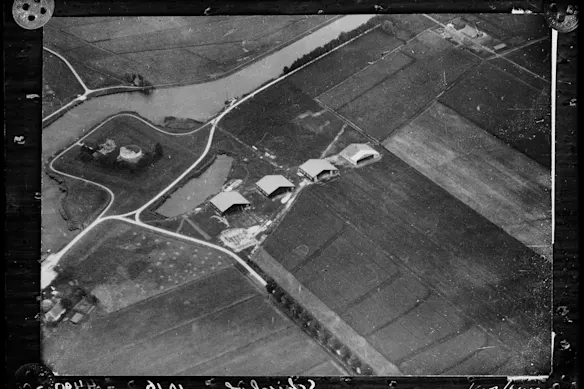
In January 1916, farmer Knibbe from the Haarlemmermeer area sees a soldier appear on his land. Colonel Walaardt Sacré is looking for a site for an airfield. Knibbe sells his 12 hectares (roughly 18 football pitches) of land for 55,290 guilders (equivalent to around €450,509). On 19 September 1916, the first military aircraft lands. This marks the beginning of Schiphol as a military airfield. Schiphol expands rapidly and by 1917 it is one of the largest airports in Europe.
© Photo: Collectie: NIMH
The best day out
1923
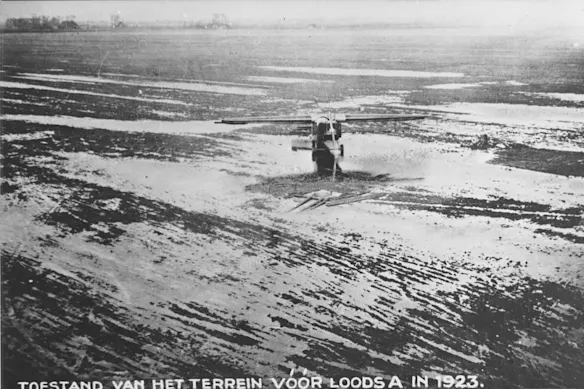
In the early years, Schiphol does not yet have any paved runways. This causes problems, as the water table is high and the planes are getting heavier. The marshy airfield has various nicknames, including ‘Moeras Schiphol’ (Schiphol Swamp) and ‘Schiphol Modderhaven’ (Schiphol Mudport). The French even refer to it as ‘Schiphol-les-Bains’.
© Photo: Amsterdam City Archives
1926
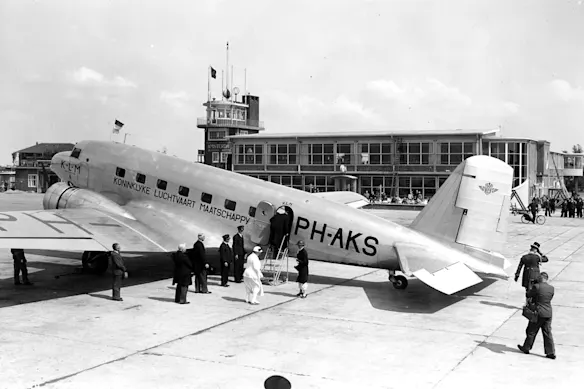
On 1 April 1926, the agreement is signed for Schiphol to become part of Amsterdam. Prior to this, the airport had been under the control of the Ministry of War. The local council sets to work straight away, as the Olympic Games are due to be held in Amsterdam in 1928. The airfield and access roads are improved, a concrete apron is constructed and a terminal building with control tower is built. Schiphol becomes a favourite day-trip destination.
© Photo: Amsterdam City Archives
Schiphol must stay
1938
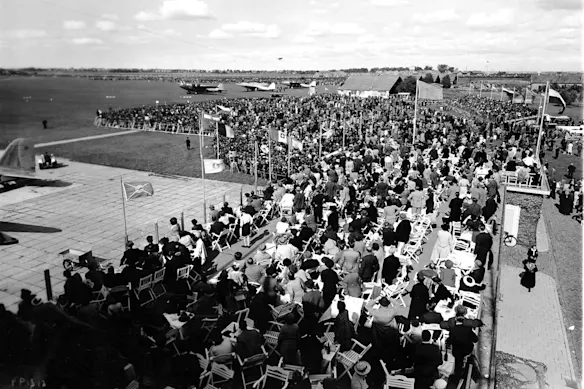
For a moment, it seems as though Schiphol might have to close. There are calls in political circles to build a new airport in a more central location within the Randstad. That would spell the end for Schiphol. People take action to save the airport, setting up S.O.S. Schiphol! A full-scale mass demonstration is even organised, and people don’t have to pay an entrance fee for the occasion.
© Photo: Amsterdam City Archives
New horizons
1945
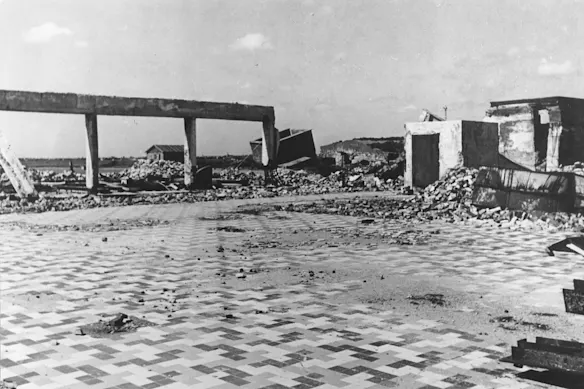
On 10 May 1940, Germany invades the Netherlands. The Luftwaffe uses Schiphol as an airbase during the war. Its new name is Fliegerhorst 561. It is a key airport for the Germans. On 13 December 1943, 200 American bomber planes bomb Schiphol. Nearly 1,600 bombs are dropped. In 1944, the Germans’ defeat is on the horizon. Their Sprengkommandos bomb the remaining runways so that the airport is completely unusable. On 8 November 1945, the government nevertheless designates Schiphol as the ‘international airport of the Netherlands’. Reconstruction has already begun.
© Photo: Amsterdam City Archives
1949
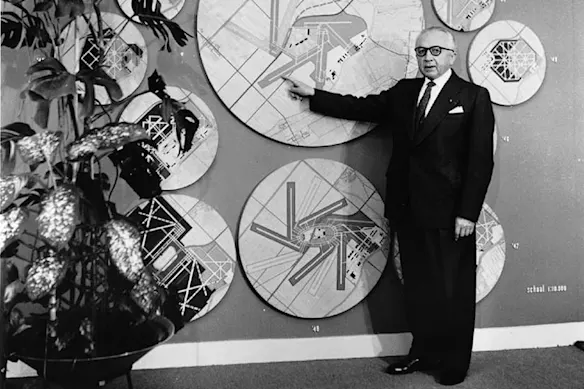
Immediately after the war, airport manager Jan Dellaert travels all over the world to seek inspiration for the new Schiphol. Whilst the old Schiphol is being patched up with a semi-permanent glass terminal, Dellaert is mentally building the future a few kilometres away. In 1949, he presents his first expansion plans for the airport. In addition to a modern control tower, the airport is to feature six to ten runways arranged around a new terminal. A new motorway and a railway line between Amsterdam and The Hague are also on Dellaert’s wish list.
© Photo: Schiphol
See Buy Fly
1955
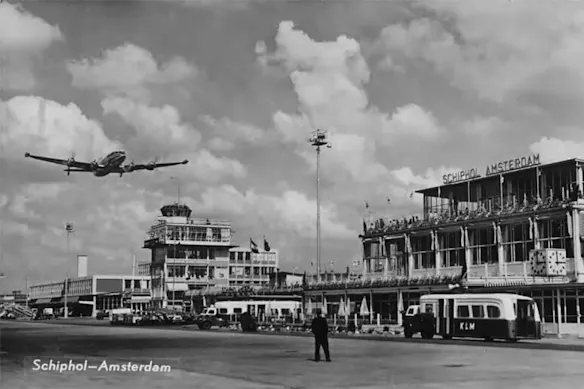
Schiphol is already a major tourist attraction by the 1920s. In 1955, more than a million paying day-trippers visit Schiphol. That’s more visitors than the Rijksmuseum. Not everyone can afford to fly, but a trip to Schiphol is still a special day out. During this period, revenue from day-trippers is one of the airport’s main sources of income.
© Photo: Amsterdam City Archives
1957
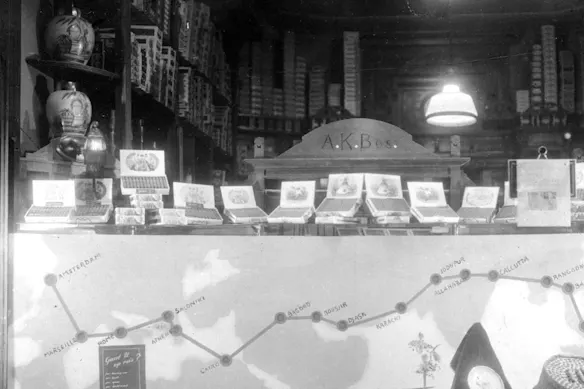
In 1957, the first duty-free shops open at Schiphol. A bottle of jenever costs 4 guilders (€8,80) and a bottle of whisky 8 guilders (€17,60). In the first year, the total turnover of the duty-free shops amounts to the equivalent of approximately 3 million euros. Fifty years later, that figure stands at 400 million euros.
© Photo: Schiphol
1958
Civil aviation is coming of age and aircraft are getting bigger. Gradually, propeller-driven planes make way for jet aircraft. These fly higher and faster than propeller planes and are also considerably heavier. Schiphol’s runways therefore need to be overhauled. In 1960, the airport gets a new 3,300-metre-long concrete runway: the Kaagbaan.
© Photo: Amsterdam City Archives
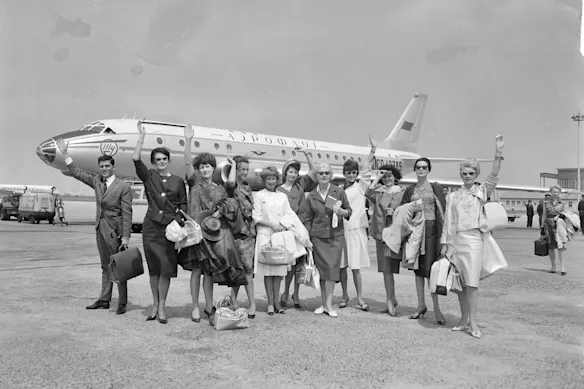
The relocation
1967
In 1961, the Schiphol Station Building Construction Agency (BSS) is established. This project agency is responsible for the overall design of the airport, with the aim of ensuring flexibility of operation and preparing for future growth. The decision to build a central terminal within the runway system makes Schiphol unique. This was Jan Dellaert’s original idea. Thanks to this design, runways never cross one another. And if the wind changes direction, other runways can be deployed quickly. It’s a design that is logical, flexible, dynamic and well-suited to our flat landscape and changeable wind conditions. The arrivals hall is on the ground floor, the departures hall on the first floor. Three piers are connected to four runways. Construction of the new Schiphol began in 1963. Four years later, in 1967, Queen Juliana opens the new terminal building. This building is situated to the west of the old Schiphol, which from that point onwards is known as Schiphol-Oost.
© Photo: Amsterdam City Archives
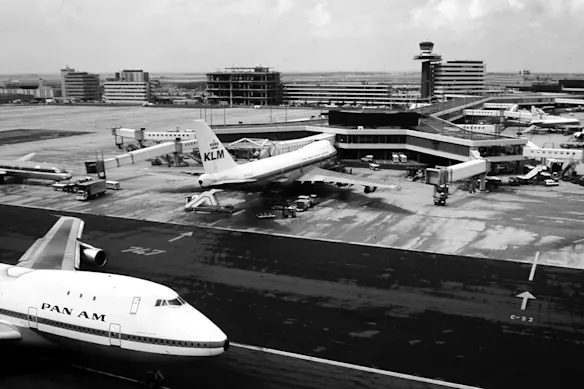
Growth spurt
1975
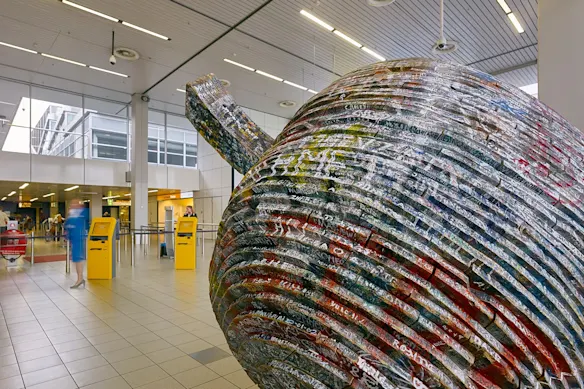
Schiphol is expanding rapidly and can now handle 15 million passengers a year. Pier D is opened and can accommodate the latest and largest aircraft. As a token of appreciation, the contractor consortium responsible for the expansion presents the Schiphol management with a work of art: a huge apple by artist Kees Franse (1924–1982). The spruce wood Schiphol apple remains clean for exactly eight days after being installed. Then the first scratched-in names and dates appear, and all hell breaks loose. Pencils, pens, felt-tips and spray cans – visitors use all sorts of things to show that they’ve been to Schiphol. Kees Franse is perfectly fine with it all. ‘The Apple has clearly gone down well,’ he later remarked. Over the years, Schiphol builds up a large art collection.
© Photo: Schiphol
Master Plan
1989
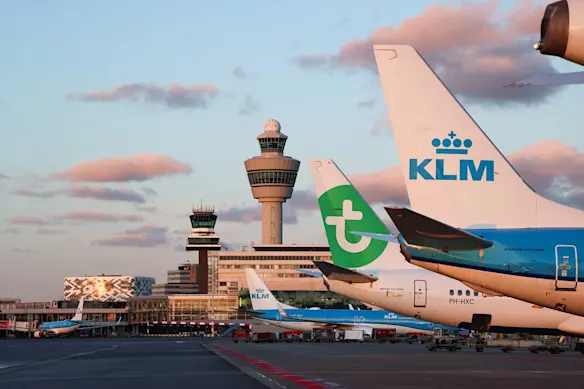
In 1989, the airport presents the Schiphol 2003 Master Plan. Schiphol is to function as a ‘mainport’ for Europe. The term ‘mainport’ was coined at a meeting in the Netherlands; the word does not actually exist in English but means major logistics hub. Due to all the new construction around the terminal, a new control tower is needed to maintain a clear view of the aircraft on the taxiways. It is completed in 1991 and, at 101 metres high, is the tallest control tower in the world at the time.
© Photo: Schiphol
City in the polder
1997
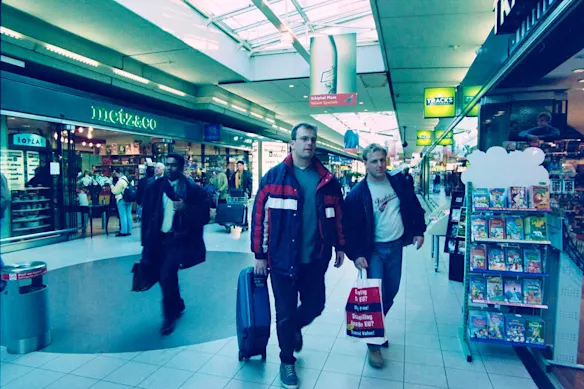
The terminal continues to expand into Schiphol Plaza and increasingly becomes a real tourist attraction. People no longer come just to watch the planes but also want to shop and eat at one of the many restaurants. And they want more. In the years that follow, the airport opens a library, bank branches, hotels and even a casino. In 2002, a temporary branch of the Rijksmuseum Amsterdam also opens its doors.
© Photo: Schiphol
Fifth runway
2003
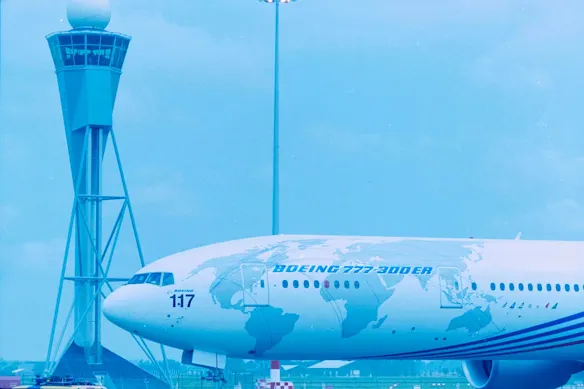
The Polderbaan, the fifth runway at Schiphol, is put into service. This name was chosen as the winner of a competition organised amongst local residents. The Polderbaan Runway takes some of the pressure off the Zwanenburgbaan Runway, meaning neighbours experience less noise nuisance. Flights at Schiphol operate according to the principle of strictly preferential runway use. This means runways are deployed in such a way as to minimise disruption to the local area. At 3,800 metres-long, the Polderbaan is the longest runway at Schiphol. It soon becomes apparent that air traffic control does not have a clear view of the runway. Consequently, a second control tower is built on the other side of the A4 motorway.
© Photo: Noord-Holland Archives
2014
On 17 July 2014, a Malaysia Airlines Boeing 777 crashes in Ukraine. The aircraft, with registration number MH17, was shot down by a surface-to-air missile at an altitude of 10 kilometres. Armed conflict had already been raging in Ukraine for several months. The aircraft was en route from Schiphol to Kuala Lumpur. All 298 people on board (including 193 Dutch nationals) are killed. Much remains unclear regarding the circumstances of the disaster.
© Photo: Schiphol

Royal status
2016
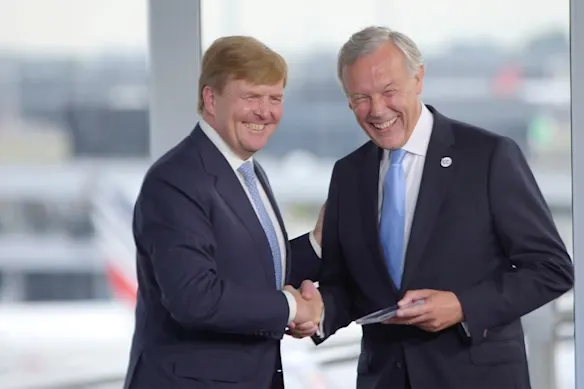
On 19 September 2016, Schiphol celebrates its 100th anniversary. Five days earlier, Chief Executive Jos Nijhuis received the ‘Royal’ designation for Schiphol Group from King Willem-Alexander and Johan Remkes, the King’s Commissioner for Noord-Holland. From that moment on, the airport company is known as Royal Schiphol Group. In that anniversary year, the national airport contributes 1.4 percent to the gross domestic product.
© Photo: Schiphol
New plans
2020
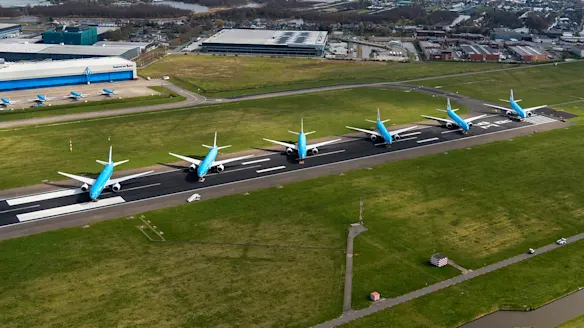
The global outbreak of the infectious disease COVID-19 leads to the Netherlands going into lockdown in 2020. This also has consequences for Schiphol. Passenger numbers fall by 62 percent in the first half of the year and the number of flight movements is more than halved. As a result, the airport decides to scale back its operations and ‘Core Schiphol’ comes into effect at the end of March. Some lounges are closed, as are most security and passport control points. Two piers remain open, whilst most of the others are used for aircraft parking.
© Photo: Schiphol
2025
Schiphol unveils a new strategic plan and is set to invest €10 billion over the next ten years. Quality and balance are central to the new plans for the future. We continue to invest in the quality of the airport. We are doing this to improve the passenger experience, ensure good working conditions and provide better service to airlines. At the same time, Schiphol is working to reduce noise and become more sustainable. With these new plans, we aim to contribute to the economy of the future and the progress of the Netherlands.