Schiphol and partners Making the F&B offering more sustainable
As a central hub for world travellers, Schiphol connects people with the world. Now and in the future. We want happy travellers, airlines and employees. And we want to be in balance with the surrounding environment.Together with our Food & Beverage (F&B) Business Partners, we aim to offer high-quality, diverse, recognisable and increasingly sustainable catering. We are committed to reducing emissions in the supply chain by expanding the plant-based F&B offerings and by prioritising people, animals and nature in our food and beverage procurement.
Here are the steps we are taking together with our partners1:
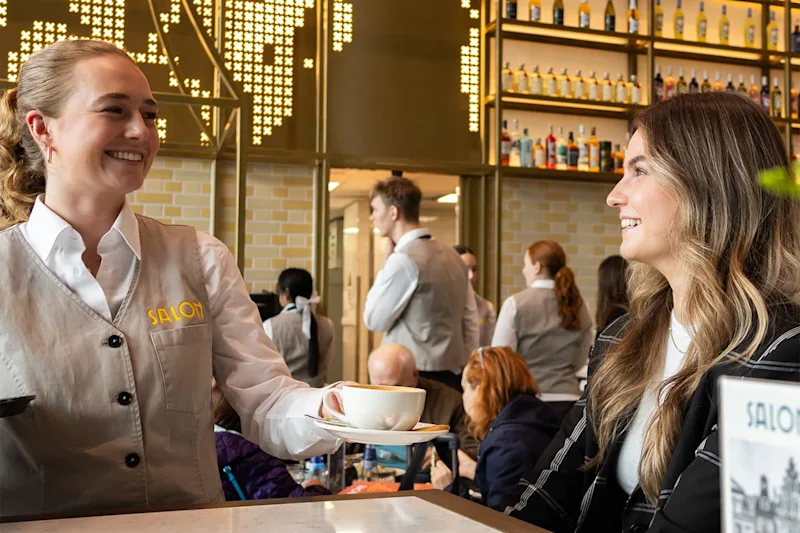
The more responsible choice always within reach
Goals:
- 60% of the food and dairy offerings will be plant-based by 2030, based on ingredient volume.
- 50% CO2e reduction across the entire food offering by 2030 compared to 2023, measured in CO2e per kg of product.
All of Schiphol's F&B partners are committed to reducing the CO2 emissions of all their business activities. Considering animal products account for a large share of the CO2 emissions from Schiphol's catering outlets, it is important to increase the plant-based offering. By doing this, we want to make it easier for consumers to make plant-based and therefore more responsible choices.
More responsible and conscious procurement for people, animals and nature
Schiphol takes responsibility for the entire F&B chain together with its Business Partners. The F&B outlets at Schiphol identify four major and impactful product groups for ingredient procurement: animal protein (meat), fish, cocoa & coffee, and fruits & vegetables. For each of these groups, Schiphol F&B opts for independent certifications. Additionally, in line with legislation, we will procure all products deforestation-free by 2025. Each product group has specific goals that are refined annually. By using a step-by-step approach with our F&B Business Partners, we stay in control of the price of our F&B offering and we avoid sudden and significant price increases.
Let’s reduce, reuse and recycle together
As much as possible, current waste is reduced before it enters the airport, and the remainder is given a second life. Within waste we distinguish two streams: the operational waste stream and the construction waste stream. For the first stream, Business Partners will contribute by rethinking packaging materials. This will be done through correct purchasing, with a focus on reducing materials and food waste during preparation.
We have set an ambitious target for operational waste streams. By 2030, we aim to recycle around 70%, compared to approximately 35% in 2024. To achieve this, we are focusing on five types of waste that together account for around 90% of all material flows (12,000 tonnes in 2023). We have chosen these waste streams because they have a significant impact on CO₂ emissions (such as residual waste, CAT-1, paper and cardboard), because they are subject to regulations (such as plastic drink cartons and residual waste) and because they can be effectively reused (such as food waste).
We aim to achieve this by improving waste separation, strengthening waste management with our partners and waste processors, and investing in shared facilities. In doing so, we are considering what best aligns with our strategy, the relevant regulations, the expected rise in CO₂ and waste taxes, and how we can enhance the traveller experience.
But we can't reduce residual waste on our own. That's why Schiphol is working with our hospitality partners and waste processors to give waste a second life and make it easier for consumers to reduce waste and dispose of it properly. We do thispartly through clear communication at the waste bins. By separating waste properly, we can make a future without waste possible.
For the construction waste stream, Schiphol is working with the catering partners on a ‘circular construction requirements set’ to make this stream as small as possible during the construction of the catering locations, now and in the future. The design of a catering outlet must be designed to be dismountable so that parts can be easily replaced, and materials can easily be given a second or third life at the end. The materials must also have the lowest possible environmental impact, and we want to ensure that the share of reused material is increased. For consumers, this means they are welcomed in a more circular environment to enjoy their beverage, hot meal or snack.
1 More detailed information concerning the roadmap and how we will keep track of progress will follow on the website soon
Questions?
If you have any questions or suggestions you can reach out via social media channels and our customer service.