Separating aircraft waste
Separating aircraft waste
Separating aircraft waste
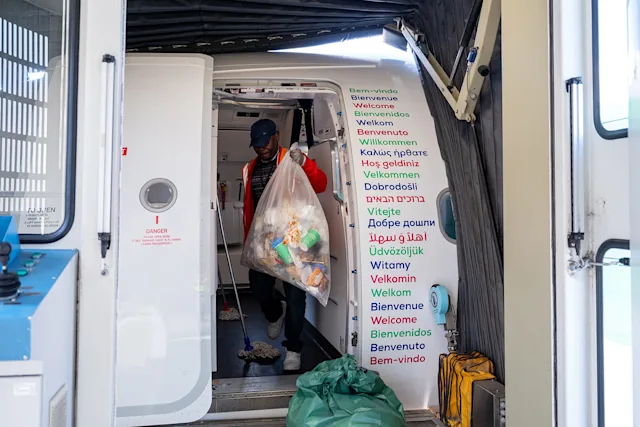
At home, it's pretty easy – you place a few different bins and in no time you have your own waste station. Separating aircraft waste, however, is a complicated task. That’s why most of it is incinerated. A waste, thought Schiphol and Transavia. And so they carried out a pilot together to find a solution.
Separating aircraft waste
Separating aircraft waste
Separating aircraft waste
More and more airlines are doing their best to collect waste separately during flights so that it can be recycled or reused. But it’s not easy. Space on a plane is limited, but the biggest stumbling block is legislation. Residual waste from EU and non-EU flights is taken to the collection point at Schiphol all mixed together. The fact that the origin of a waste bag is not clear is a major legal problem.
Why? European legislation divides residual waste into categories. Waste from outside the EU falls into category 1 and, by definition, is considered high-risk. This is because it may have been in contact with animal produce waste, such as cheese or meat, which does not meet strict EU standards. This type of waste may only be taken to landfills or incinerated. Animal waste from an EU country does meet strict EU standards. This puts residual waste from the EU in category 3, which can be recycled. But because the collection point receives waste from all kinds of flights mixed together, the origin is no longer clear and everything has to be incinerated.
If, like Schiphol, you have the ambition to recycle or reuse all your waste by 2030 and not send anything to be incinerated anymore, you have to come up with a solution. Airlines, such as Transavia, also have recycling ambitions and are looking for ways to deal with this issue. The large amount of aircraft waste only makes tackling the origin problem more urgent. In 2024, Schiphol processed 3,000 tonnes of aircraft waste. Most of this currently goes to the incinerator, but a lot of it could be reused if the country of origin was known.
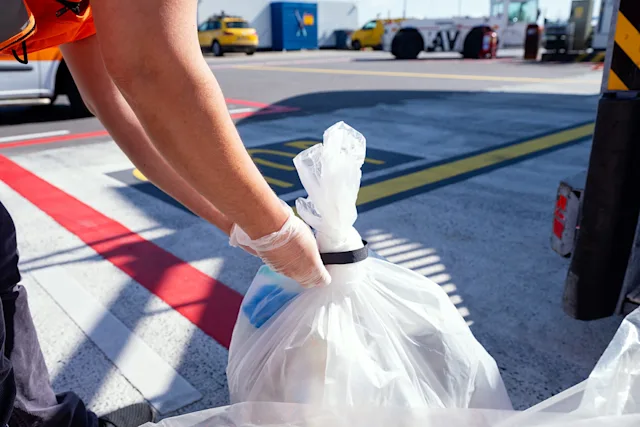
The solution Schiphol came up with is an RFID tag, with privacy-aware technology that has no GPS or personal tracking. Every rubbish bag coming off board is given such a tag by the cleaning company. This shows the airline and origin of the flight. When all bags reach the Renewi collection point, they are registered, weighed and sorted. What’s unique is that the airline receives data on the contents of the bags. This data can be used to meet its own recycling targets, for example by choosing product ranges with more recyclable packaging.
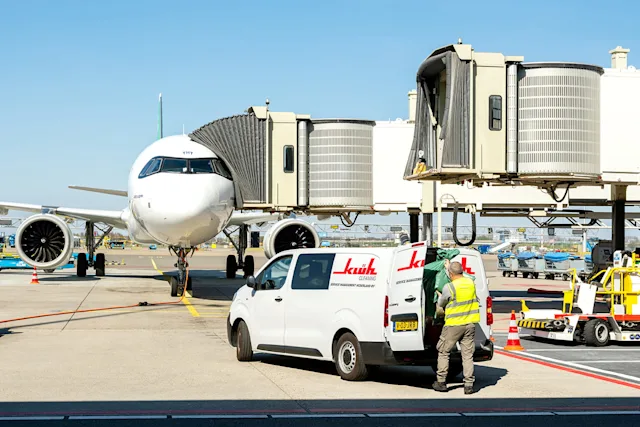
Schiphol recently tested the new system in practice for the first time, together with waste management company Renewi, various airlines and cleaning companies Klüh and Asito. The first pilot involved only Transavia's night flights. At night, it is quieter and there was more time to get the hang of tagging. The tests that followed were carried out throughout the day during operations. The main focus was on the impact of tagging on the operational process, as the extra step must not cause any delays. Fortunately, it turned out that tagging can be easily integrated. Tests were also conducted in collaboration with cleaning company Asito, involving multiple airlines. This gave us even more insights into how the process works in practice and where improvements are possible. In this way, together with our partners, we are taking another step towards a zero-waste airport at Schiphol.
Schiphol carried out this pilot with Transavia, recycling company Renewi and cleaning companies Klüh and Asito, among others. The RFID tag was developed by software supplier Mieloo & Alexander.