
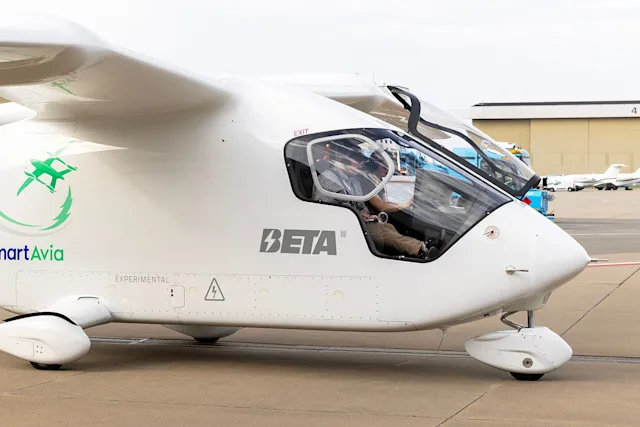
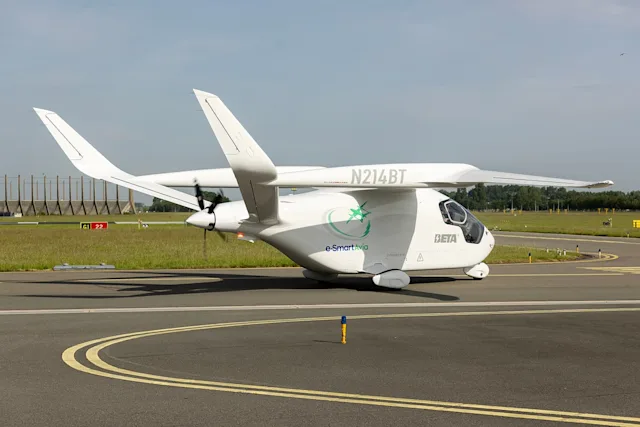
Electric air cargo transport is one step closer. On 29 May, Schiphol took part in the first test flights in the Netherlands featuring a fully electric cargo aircraft, the BETA ALIA CX300. The test flights were organised by e-Smart Avia and all the other parties involved.
This test provides insight into what electric aviation demands from airports, partners and operations. This includes charging infrastructure, operational processes, cooperation with Air Traffic Control Netherlands (LVNL), noise and deployability at various airports. The initiative aligns with our ambition to work with the sector on future-proof aviation with reduced emissions and noise.
The flight departed from Amsterdam Airport Schiphol and proceeded via Den Helder Airport and Lelystad Airport to Rotterdam The Hague Airport. On 30 May, a flight followed to Ostend-Bruges Airport in Belgium.
As an international logistics hub, Schiphol plays an important role in the Dutch economy and in connecting the Netherlands to the world. Our participation in this initiative underscores our contribution to future-proof aviation and logistics.
We are working towards aviation with lower emissions and noise. These test flights show how electric air cargo can contribute to this in the long term, while the Netherlands further develops its strong position as a logistics hub. For Schiphol, participation in this test is a way to gain practical experience together with partners and to better understand what is needed to enable commercial electric aviation in the Netherlands in the future.
Electric flying could eventually become a complement to existing air cargo, especially for short routes and time-critical shipments such as organ transport. e-Smart Avia will operate the BETA ALIA CX300, with a load capacity of up to 560 kilos and a range of up to approximately 600 kilometres, on short national and international routes from the Netherlands.
Our country has a unique combination of strong logistical infrastructure, short distances to other major economic centres at home and abroad, and a proactive attitude towards innovation and sustainability. This makes the Netherlands an ideal environment to test and scale up electric aviation.
The ultimate goal is to connect major hubs such as Schiphol with regional airports to create an efficient and distributed cargo network.
e-Smart Avia aims to start the first commercial cargo operations by the end of 2027, depending on factors including permits, infrastructure and aircraft availability.