Blog · 19 May 2025 Four things you may not yet know about Schiphol
The length of our runways, why we have half an alphabet of piers and the surface area of Schiphol? Read this blog full of interesting facts that you probably didn't yet know and impress others with your factual knowledge about our airport.
Larger than Delft and Leiden
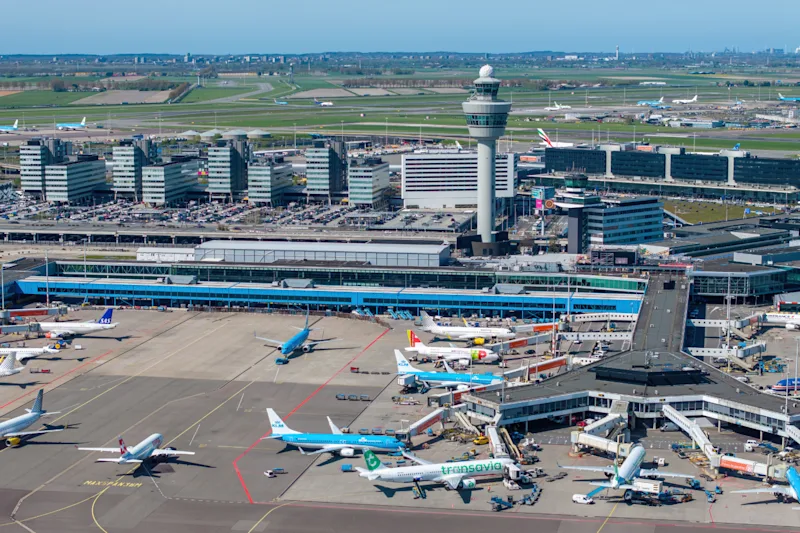
Whoever has landed on the Polderbaan Runway or walked around the terminal will know that Schiphol is very big. The exact surface area of the airport? Almost 28,000,000 metres squared. That's larger than both Delft and Leiden! Runways and grass take up a significant proportion of this area, but the terminals and piers are also of a considerable size. Together, they cover an area of around 650,000 metres squared.
Polderbaan the longest runway
How long are all those runways? The Polderbaan Runway is the longest (3,800 metres) and widest (60 metres). The Kaagbaan Runway (3,500 metres), Buitenveldertbaan Runway (3,450 metres), Aalsmeerbaan Runway (3,400 metres) and Zwanenburgbaan Runway (3,300 metres) are all more than 3 kilometres long. Only the Schiphol-Oostbaan Runway is considerably shorter, measuring slightly over 2,000 metres. However, that's not a problem as we generally only use it for smaller (private) aircraft.
Why so many?
There are six runways in total. Why so many? This has to do with the location of our airport, in the middle of the windy Dutch polder landscape. We strive to have as many planes as possible take off and land upwind. Because the wind direction changes here from time to time, it's useful to have runways facing different directions. Another reason is noise. To prevent noise nuisance as much as possible, we cannot use all runways with equal frequency.
Half an alphabet of piers
When you look at the names of the piers at Schiphol, you get the feeling that someone didn't pay attention at school. Because why is there a B to H and an M pier, but no A, I, J, K or L? The reason there is no A pier is because the English pronounced 'A' sounds too much like the Dutch 'E'. It was thought that this could lead to confusion. With the future in mind, however, we have now moved away from that idea. The reason why we go straight from H to M is a bit more complicated. I and J seem too similar - certainly from a distance - and in English 'J' and 'G' sound the same. The letters K and L were once reserved for a never-realised elevation of piers G and F.