To and from the airport

In the short term, more sustainable fuels are the best option for reducing flight emissions. These fuels are biokerosene and synthetic kerosene. The main advantage is that these fuels can be used in existing aircraft; technical adjustments are not needed. Furthermore, biokerosene is already available on the market.
More sustainable fuels are also known as Sustainable Aviation Fuel (SAF). Although the name suggests otherwise, they are not yet 100% sustainable. These fuels produce 70 to 90% less CO2 than fossil kerosene, but some emissions do remain.
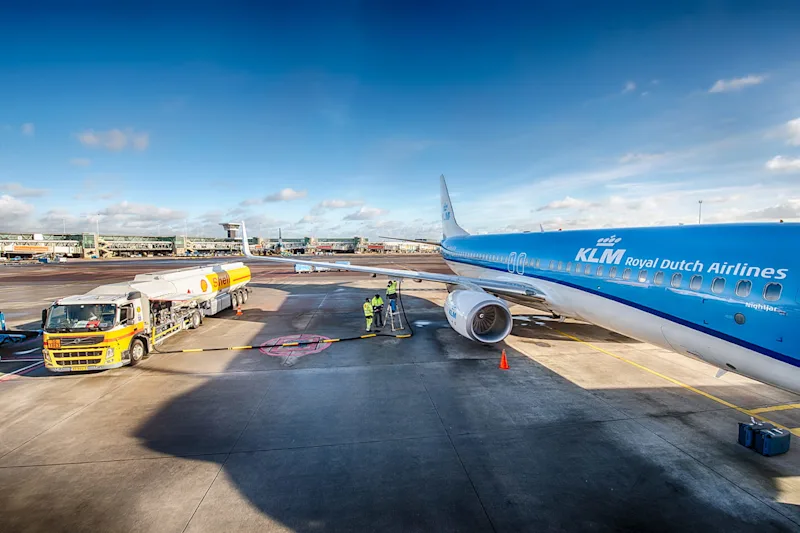
The more sustainable fuel biokerosene is already available at Schiphol. It is made from vegetable or animal waste products, such as cooking oil. Airlines use biokerosene at Schiphol on a small scale.. The main reason is that it’s almost three times more expensive than regular kerosene and has limited availability. Between 2022 and 2024, Schiphol encouraged the purchase of SAF by subsidising the additional costs. As a result, more than 40,000 tons of SAF was used by participating airlines.
To make synthetic kerosene, CO2 extracted from the air is converted into fuel using hydrogen or electricity. This is done in the most sustainable way possible. It is not yet on the market, but still in development. KLM and Shell have already demonstrated that it is safe to fly with. On 22 January 2021, KLM operated the first flight (Schiphol-Madrid) for which a small amount of synthetic kerosene was blended with standard fuel. Schiphol supported two research projects that investigated the development of synthetic kerosene. These projects have since been discontinued. Other organisations are working on further developing e-SAF.
SAF is still very expensive. That keeps supply and demand low.The European Union has introduced a fuel blending mandate for SAF. As of 2025, 2% of fuel must be SAF. This percentage will rise to 6% by 2030 and 70% by 2050. Some of this SAF must be synthetic kerosene.
Schiphol, together with Natuur & Milieu, BARIN, KLM, SkyNRG, Power2X and the North Holland Environmental Federation (Natuur & Milieufederatie Noord-Holland), has published a joint position paper setting out recommendations to the Dutch Government and the European Union to support the accelerated deployment and large-scale adoption of e-SAF (Sustainable Aviation Fuel).